
It is important for Content Creators to protect their most important intellectual property, their stage name. Many people who star in any type of an adult content do so under an assumed stage name. Rarely, do they perform using their actual legal name. One of the benefits of performing under a stage name is that stage names can be trademarked. Trademarking your stage name provides several benefits to Content Creators. First, you can prevent others from using the same name, withing adult entertainment, to gain fans/followers based on your popularity. Second, having your stage name trademarked allows you to more easily police fake social media accounts and have them terminated. Instagram, Twitter, Facebook, TikTok and most other social media sites have a way to report trademark infringements. Reporting a fake account as a trademark infringement is a more serious allegation than just reporting a fake profile. A claim of trademark infringement requires social media platforms to act on you report. Finally, if you also use your trademark as a watermark on your photos/videos, it can also help stop the piracy of your content. However, I will cover that issue in the next installment.
There are three types of trademarks in the United States, common law trademark, a state trademark, and a federally registered trademark. It is rather easy to get a common law trademark – it just requires the use of that stage name in commerce – meaning once a Content Creator opens a for-profit website with it and/or just starts using it as their stage name when they are booked into scenes and paid for those scenes. Commerce means the Content Creator must be using the name to make money. Unfortunately, a common law trademark is rather weak when it comes to protecting a “brand.” Common law trademarks are usually restricted to geographical locations and the industry the name is used in. For instance, if you choose “Suzie Suckems” and use that name as your stage name you do have a common law trademark in “Susie Suckems.” Your common law trademark for your name will probably be restricted to the geographically area known as Los Angeles County (if you perform and live there). Also, you would probably only be able to enforce that common law trademark against another Content Creator using the stage name “Susie Suckems” only in Los Angeles County and only as a stage name. Anywhere else the other “Susie Suckems” could use that name as a stage name, and you would be unable to prevent her use of it. For instance, if the other “Susie Suckems” traveled to Florida to shoot she could certainly use it there.
A Content Creator can also file for a state trademark; however, I have never heard of anyone securing a state trademark. I do not believe that a state trademark provides any advantage over a federal trademark. I would never recommend that a Content Creator-client register a state trademark before attempting to secure a federal trademark. Federally registered trademarks provide much more protection than a state trademark. Therefore, I always recommend that Content Creators secure a federal trademark first. However, if you would like to research California state trademarks you can find more information here -> http://www.sos.ca.gov/business/ts/
If you would like to research other state trademark laws you can go here -> http://www.uspto.gov/trademarks/process/State_Trademark_Links.jsp
If a Content Creator does decide to trademark their stage name this is a relatively easy process for an experienced trademark attorney, though it does take a rather lengthy amount of time. Most Content Creators think that once the trademark fees are paid and the paperwork is filed that is all that is necessary, and they immediately have their trademark. That is not the case. It can take up to a year or longer to secure a trademark. It is a detailed process and often Content Creator’s stage names are challenged or rejected depending on what the name is or how the trademark description is written. While it may seem easy, it can get complicated if the USPTO’s (United State Patent and Trademark Office) attorneys require additional information or issue office actions against the registration.
A Content Creator can certainly file their own trademark. For more information on how to do so you can look here -> http://www.uspto.gov/trademarks/process/index.jsp
What many Content Creators do not understand is that usually multiple trademarks need to be filed depending on what uses the Content Creator wants to protect. For example, one trademark in Class 41 will not protect that stage name for the use on t-shirts. The manner in which a trademark operates to protect a brand is that a company or Content Creator has to register that trademark for each use that want to protect it for. Quite simply, to protect their stage name on the Internet would be one registration. To protect that same stage name for a line of t-shirts that would be an additional filing. If the Content Creator wanted to protect a wide range of uses many filings would be necessary. For example, the owner of the mark “Fifty Shades of Grey” has filed the following trademarks.
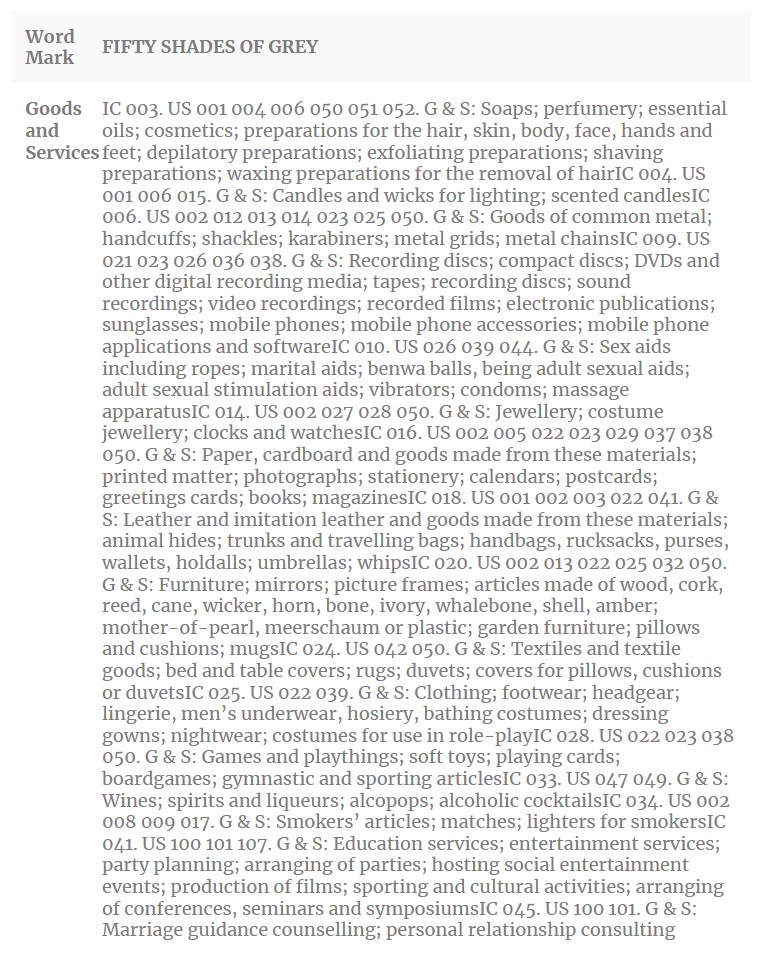
You can see that the owner of the mark wanted to protect their trademark for all possible uses, not just for a book or movie. More than $5,000.00 was paid just in registration fees for all of those uses in addition to the actual attorney’s fees paid for each filing. I often caution Content Creators from trying to file too many registrations at once. It is often better to secure the main use first and then move towards additional uses as business opportunities allow. Otherwise, it may be a rather expensive experiment to determine whether you can even secure the trademark for the first use. For example, if your Content Creator name is “Trixie Minaj” you may have difficulty in securing even the first trademark. Especially, if you have given interviews early in your career that you picked that name because people told you that you look like “Nicki Minaj.” The way the trademark process works is that once your trademark is filed it is reviewed within a couple of months by the staff attorneys at the USPTO. If all the forms are properly filled out and the necessary samples of the use of the stage name are properly submitted your trademark will eventually be published for opposition. Which then means anyone can object to your trademark, if for some reason, your trademark is too close or infringes on their intellectually property. In this example, you can be assured that Nicki Minaj has attorneys that do nothing more than watch to see if anyone has tried to secure a trademark using her name. Once they do find it you can assume they will object to your trademark. If you have filed your trademark request in 10 different categories for 10 different uses, you will probably lose all of those filing fees as well as
 Forming a new Limited Liability Company is exciting. It can mean the start of a new idea, a new dream, or just a new way of doing business better than before. Forming a new LLC for an online entity is just a small step on what should be a long run of doing business, but some entrepreneurs make a big decision by choosing a specific state with little to no grounds for their choice. Why is so little thought put into choice of venue when the new LLC could be formed in any one of a variety of states?
 Chad Anderson is an accountant and attorney licensed to practice in Arizona, Nevada, and Iowa.
 This will be the last of my 5 articles pertaining to content production for Content Creators that post their content up for sale on various platforms such as OnlyFans.com, AVNStars.com, JustFor.Fans and even ManyVids.com and Clips4Sale.com.
 acts is guilty of disorderly conduct, a misdemeanor: (a) An individual who solicits anyone to engage in or who engages in lewd or dissolute conduct in any public place or in any place open to the public or exposed to public view.” Lewd conduct can also occur if you touch your genitals, buttocks or female breasts in public for the purpose of sexual gratification, or to annoy or offend someone else. The more serious the lewd conduct the more likely you will be charged with a felony instead of a misdemeanor. If you are engaged in public sex, it is fairly reasonable to believe that you will receive a felony charge.
 Protect Your Content !
 Work for Hire Agreements? Do you own your content?
 Now you’ve read Part 1 of my five part series, we can continue on to the next lesson – Model Releases. If you have not read Part 1 – you can read it here;
 Are you new to OnlyFans or one of the other Content Creator platforms such as AVNStars.com, ManyVids.com, Clips4Sale.com, IWantClips.com, JustFor.Fans ?
 There seems to be a disagreement amongst producers, performers and even testing facilities as to when adult studios can resume production. The Free Speech Coalition continues to state that all adult productions are on a hold while many states attempt to slowly reopen their societies. Their decision has been backed by one of the Free Speech Coalition’s largest financial supporters, Mindgeek – ie., Brazzers and Pornhub. While, on the other hand, Talent Testing Services and Sixto Pacheco, the owner, has added COVID-19 testing to the performer panel test through-out the United States. Thus, hinting that with a full panel testing including that for COVID-19, studios and content creators can get back to making pornography with one of their tests.
 AdultBizLaw.com