Discrimination Against Pornstars, Escorts, Kinksters and Swingers

One area of law that often receives much publicity in the mainstream media is employment law. There are always news reports of litigation about sex discrimination in the work place. Media loves reporting on multi-million dollar judgments in sexual harassment cases, especially those involving celebrities. They also love a story involving a pornstar getting fired from a job because of his/her porn-past.

Recently, I appeared on Taboo Fetish Radio, hosted by Sydney Screams and Whitney Morgan, to talk about what protections current and former pornstars, escorts, sex workers and even those with an alternative lifestyle such as Kinksters or Swingers have in regards to being singled out and fired from their jobs ( Please see:  http://www.blogtalkradio.com/porn-star-radio/2012/09/20/taboo-fetish-talk ).

In a recent case that is still being litigated, Ms. Stacie Halas, a middle school teacher, was fired from her teaching position with the Oxnard School District in California on April 18, 2012 for her involvement in pornography movies. ( Please see: http://www.vcstar.com/news/2012/jul/23/judge-to-hear-dismissal-case-of-oxnard-teacher/ )

“The school board voted unanimously April 18 to fire Halas, saying her continued employment would disturb the classroom environment. Halas appealed the decision to the Office of Administrative Hearing, a quasi-judicial tribunal that handles such disputes. In a notice of defense, Halas’ other attorney, Rich Schwab, says Halas did nothing illegal and is fit to teach.

In accusation documents filed with the Office of Administrative Hearing, the school district says Halas lied about her connection to pornography and about the reason she resigned from a neighboring district. In the days after the discovery of the pornographic movies, district officials said students talked about and watched the movies on campus, and a classroom where Halas once taught was vandalized.”

It appears from this quote that the underlying reasons for Ms. Halas’s termination was not actually her involvement in pornographic movies but rather the falsification of her employment application. This is a common way for employers, especially in California, to fire an employee at anytime for basically any reason. Many state and federal courts have held that if an employee lies on his/her employment application then they have basically defrauded the employer into hiring them and thus has no legal recourse even if they were fired illegally. The doctrine of unclean hands comes into play and that falsification can act as almost a complete bar to later claims by employee for being fired for a non-lawful discriminatory cause such as race, gender, sexual orientation, skin color or place of national origin.

Basically, if you lie on your employment application you will have a mountain to climb to even be able to sue your employer for any reason, even if your boss tried to force you to provide him/her sex on the job in exchange for not firing you ( You would still have a lawsuit against your boss individually though ).

Courts have generally adopted the following line of reasoning as noted in Summers v. State Farm Automobile Ins.,  ; ( Please see: http://bulk.resource.org/courts.gov/c/F2/864/864.F2d.700.87-1087.html )

Many of the courts have accepted an analogy posited in Summers : “The present case is akin to the hypothetical wherein a company doctor is fired because of his age, race, religion, and sex and the company, in defending a civil rights action, thereafter discovers that the discharged employee was not a ‘doctor.’ In our view, the masquerading doctor would be entitled to no relief, and Summers is in no better position.”

Courts are rarely sympathetic to employees that are less then truthful when applying for employment. A prospective employee that has a past in pornography, prostitution or even an alternative lifestyle may not be desirable hiring choice for many employers, especially those that have mainstream visibility or conservative clients. Even visible tattoos has been an issue in regards to being employment.

Obviously, prior employment or self employment is a much larger issue when it comes to future employment applications. Those that are or have been sex workers, whether in adult films, as an escort, stripper, dominatrix, sub, unlicensed massage parlor worker or any of a number of related fields have the highest risk when falsifying an employment application. Anyone would be hard pressed to find a court decision finding that an employer, who terminated a such an employee, would be liable for a discriminatory termination. ( If any of my readers know of any such appellate court decision from any state in the United States I would very much appreciate that information.) Therefore, I am watching Ms. Halas’s lawsuit with great interest. Her claims may set a positive legal precedent as to protecting individual sexual liberties but I have my doubts.

As for lifestyle choices such as BDSM or swinging, since these do not apply to previous employment there is much less of a risk of not revealing these choices to a prospective employer on an employment application. However, if your involvement in those lifestyle choices did involve earning income from them such has producing content and selling it on a Clips4Sale.com store that might be seen as self employment by your employer.

There might be one exception to this situation. While I have found no cases on point involving sex workers or alternative lifestyle choices, there would be an argument for a terminated employee to make if the employer had discovered the falsification on the application and did not do anything about it immediately. Meaning that if you lied on your employment application and four days into your employment your employer or supervisor discovers your lie and takes no action but five years later tries to fire you for the falsification as a pretense for some other reason you might have a defensible position however I cannot state for certainty whether that would provide the basis for a victory against your employer.

The lesson in this is that if you lie on your employment application it can come back to haunt you, even many years later. Obviously being completely honest about your past or present may cost getting you a job. What you decide to reveal on an employment application is a personal decision. Just be aware of the law.

Porn 101: Choosing an Agent – Part 1

cropped-ablOnce you have made the choice to get into the adult industry the next step is making the decision as to whether you need an agent and who that agent will be. Who you choose as your agent is probably one of the most important decisions you will make as performer. Your agent will shape your career and be able to use their mainstream and industry connections to help you further your career. Your agent will be the person within the industry that you have the most contact with at first. Therefore, its important that you choose your agent carefully and research who you may be hiring to represent you. Talk to other performers about their agent(s). Twitter makes it quite easy to approach and ask other performers in the industry what they like or do not like about their agent(s). And make sure you get more then one opinion.

After choosing an agent you will have to decide whether you will relocate to Los Angeles or will you simply visit Los Angeles and work while you are there. Living in Los Angeles or traveling there will make a difference in not only how much work you can expect but also what your life will be like and how your career will proceed. From a career perspective, living in Los Angeles will probably result in more work since you can be booked at the last minute if another performer isn’t available, refuses the job offer or “no-shows.” However, living in Los Angeles is probably much more expensive than where you may live now. Also, living in Los Angeles will allow to you develop relationships, business and personal, with producers, directors and other performers that may help and assist with how your career proceeds.

I would recommend that anyone seeking an agent in Los Angeles chose only a licensed and bonded talent agent. In California, all agents are required by state law to be licensed and bonded. Also, any agent booking work for talent in California also has to be licensed and bonded in California. Even if your agent is located in New York and that agent is booking work for you in Los Angeles, they too must be licensed and bonded in California. You can check to see which agents are licensed and bonded by searching on this database -> http://www.dir.ca.gov/databases/dlselr/talag.html

Who’s Licensed & Bonded ?

According the Licensed Adult Talent Agency Trade Association ( Please see: http://www.latata.org ) the provide a list of agents that are currently licensed and bonded in adult entertainment in California.

The agents on LATATA.org is merely provided as a starting point for your own research. Choose the agent that will best serve your needs as an performer. If you are an agent and want to know how to become licensed and bonded in California please see http://www.dir.ca.gov/dlse/Talent_Agency_License.html )

What’s a Talent Agent Contract Look Like ?

As a licensed and bonded agent, your agent is only allowed to use a pre-approved Talent Agency Agreement. A California Labor Commissioner MUST pre-approve and stamp all talent agency contracts. A sample of the current Labor Commissioner approved contract can be found here -> Talent_Exclusive_Contract

If your agent hands you a contract that does not look the above contract, has additional pages or is not approved by the state of California Labor Commissioner that is not a valid talent-agent contract and you should not sign it. As a part of being licensed and bonded, every agent is required to have any changes or additions to the standard contract approved by the Labor Commissioner before providing it to talent to sign. Without such approval those pages or parts are not enforceable.

However, your agent may ask you to sign a model release and a 2257 document to place your photographs on their website. Those are acceptable to sign since your agent will need your agreement to start promoting your pictures on their website.

As a rule, your agent should provide you will copies of everything you have signed so make sure you receive copies for your records. If your agent does not provide a copy make sure you take a photograph of every page of the contract with your phone and keep those photos for your records in case you need them in the future.

How Much Do I Pay My Agent ?

If your agent is not licensed and bonded they cannot receive a fee for booking you work. Often people will claim to be managers and or publicist and attempt to book work for you. If they do, legally they cannot take a fee for doing so. Only licensed and bonded agents may collect a fee for booking work for you. The fees an agent may charge is not limited however the standard in the adult entertainment industry is between 10-20% of the total gross fee paid to the performer for each job secured. The amount of fees that the agent will charge you must be stated on the talent agency contract.

If you would like to research the laws pertaining to talent agents in the state of California please see -> http://www.agentassociation.com/frontdoor/agency_licensing_detail.cfm?id=572

In my next article on this subject I will discussed living in Los Angeles, what you can expect from your talent agent and what they are allowed and not allowed to do.

A Good Example of Why Talent Should Read Model Releases

cropped-ablBy now most of the world has heard of the film “Innocence of Muslims.” The clips of this movie prompted widespread violence and anti-American demonstrations across much of the Muslim world.

Video clips of the movie were initially uploaded to YouTube in July 2012. Videos dubbed in the Arabic language were uploaded during early September 2012. On September 9, 2012, an excerpt of the YouTube video was broadcast on an Egyptian Islamist television station. Demonstrations and violent protests against the film broke out on September 11 in Egypt and Libya, and spread to other Arab and Muslim nations and some western countries. On September 11, 2012 an armed attack occurred on the U.S. diplomatic mission in Libya in which the U.S. Ambassador J. Christopher Stevens and three other Americans were killed ( Please see: http://en.wikipedia.org/wiki/Innocence_of_muslims )

Originally titled “Desert Warrior” and shot in English. The film was transformed into the “Innocence of Muslims” by dubbing over certain lines in the movie and adding references to the Prophet Muhammad. This was obviously not what the actors had intended by their participation in the production.

So what does this have to do with porn ?

On Thursday, September 20, 2012, a Los Angeles judge denied one of the movie’s stars lawsuit to remove the videos from YouTube (Please see: http://www.washingtonpost.com/national/on-faith/actress-in-anti-muslim-movie-sues-for-its-removal-online-sues-filmmaker-for-fraud/2012/09/19/694e5cd0-02b7-11e2-9132-f2750cd65f97_story.html ). Without going into the legal analysis of why the judge denied her request what is important is the fact that this occurred in the first place.

What allowed the producer to dub over the actors’ voices was the model release and the fact that there was probably a clause in that model release giving the producer the right to do whatever he/she wanted with the movie. Now, many of those involved with the production of movie or starred in the movie are receiving death threats.

However, we may never know what the model release said since the actress who filed the lawsuit, Cindy Lee Garcia, admitted she didn’t have a copy of the model release.

In the day of the smart phones with cameras there is absolutely no reason for a performer not to have a copy/photo of every page of every model release, contract and talent agency agreement they are asked to sign. Performers should simply take photographs of the documents and keep them in their phone or email the photographs to themselves, organize them and save them on their computer. You may never know when you will need such a copy as I am sure Cindy Lee Garcia now wishes she had.

My point is not that a performer’s starring role in “Babyz Got Huge Backsides” will be turned into a religious movie that sparks international controversy but rather a performer should not end up like Cindy Lee Garcia, in court fighting about a contract dispute without a copy of the contract he/she signed.

All producers should readily provide a copy of the model release and 2257 documentation for talent. If they do not it might be simply because there is no copy machine available on set. A simple photograph of the contract can achieve the same purpose. If someone does not want to provide a performer a copy of the contract, now that’s a different issue and perhaps that performer should question their motives for not giving them a copy. In those cases I would recommend that a performer not sign anything until they allowed the right to photograph all pages of the contract.


The Problem with Producing Porn Outside California…

Yesterday the “No on Government Waste Committee” held a press conference at Manwin’s headquarters in Burbank ( http://www.xbiz.com/news/154272 ). During the press conference Valley Industry Commerce Association President Stuart Waldman (who is an attorney) made the following quote;

“This is a Los Angeles County ordinance. What would prevent companies from moving to another county to produce films — Ventura County, San Bernardino County?  What would keep them from following their brethren to Nevada, Florida or wherever else production companies are doing business? Some states would provide economic incentives for the industry to relocate.

While it is possible that the industry may relocate to a different county in California there are problems with the industry relocating to another state. Currently, the production of hardcore pornography is only legally protected in two states, California and New Hampshire ( Please see: http://en.wikipedia.org/wiki/California_v._Freeman and http://www.citmedialaw.org/blog/2008/nh-supreme-court-rules-porn-not-prostitution ). Those are the only two states that have state Supreme Court cases that have held that the production of pornography is NOT prostitution and/or pandering and is rather a First Amendment free speech right. This is why the adult entertainment industry is a legal and recognized business within California.

In all other states hardcore pornography production is a tricky legal situation. Not only because of possible criminal penalties or prosecution but because of the validity of the model releases. One of the standard contracts in adult entertainment is the model release. It’s the contract that every performer is required to sign to release their rights to the producer to forever use their images and videos for all purposes all over the world. Basically, the model release is the foundation of the entire industry. A signed model release by the performers allow the release of the scene or movie to the public for sale.

The issue to be concerned with as a producer is the enforceability of a hardcore model release. If a company produces hardcore pornography outside of California the model release might not be valid under the theory of “lawful object.” Meaning that the basis of the contract must be a lawful activity. It is clear that two people could not contract for the sale of a kilo of cocaine since the distribution of cocaine is an illegal activity. No court in the United States would enforce a contract for the distribution of cocaine.

At the heart of every hardcore pornography model release is the exchange of sex for money. While some may claim that the contract is actually for a release of rights that is not a complete view of the model release contract in regards to hardcore pornography production. For the most part, courts do not allow the exchange of sex for money to be the basis of contract. It is all most all states it is legally clear that sex cannot be the consideration of a contract. Besides hardcore pornography in California another exception to this rule is legal prostitution only in Nevada brothels (except in Clark County which includes Las Vegas).

Any contract that is based on an illegal activity would be considered void and unenforceable in a court. In other words – useless. That might leave a producer open to numerous lawsuits and costs for defending such. Without a valid model release that a court is willing to enforce the producer is left in the situation of not having a model release at all ( Please see: http://georgetownlawjournal.org/articles/sexual-reconsideration-adult-entertainment-contracts-and-the-problem-of-enforceability/ )

Without a model release the producer and the performer basically become partners in the profits of the scene. As a partner, the producer may then need to pay profits to the model instead of just a one time fee. In every model release is a paragraph that waives the performer’s rights to publicity. A performer’s right to publicity is an inherent right. Everyone has the right to determine how and for what purposes our image, likeness and names are used for commercial purposes. Without a release no one can use someone’s image to sell a product, good or service without paying that person a percentage of the profit made. That is exactly what a model release does. It says for $1000.00 (or whatever the scene rate may be) that the producer has the right to do whatever he/she wants with a performer’s image, likeness or name for whatever purpose they want to. Without that paragraph the producer then has to pay to the performer a percentage of profit.

In California this theory is set out in California Civil Code section 3344;

(a)Any person who knowingly uses another’s name, voice, signature, photograph, or likeness, in any manner, on or in products, merchandise, or goods, or for purposes of advertising or selling, or soliciting purchases of, products, merchandise, goods or services, without such person’s prior consent, or, in the case of a minor, the prior consent of his parent or legal guardian, shall be liable for any damages sustained by the person or persons injured as a result thereof. In addition, in any action brought under this section, the person who violated the section shall be liable to the injured party or parties in an amount equal to the greater of seven hundred fifty dollars ($750) or the actual damages suffered by him or her as a result of the unauthorized use, and any profits from the unauthorized use that are attributable to the use and are not taken into account in computing the actual damages. In establishing such profits, the injured party or parties are required to present proof only of the gross revenue attributable to such use, and the person who violated this section is required to prove his or her deductible expenses. Punitive damages may also be awarded to the injured party or parties. The prevailing party in any action under this section shall also be entitled to attorney’s fees and costs.

Many states have statutes similar to the California Civil Code section 3344. Florida, Illinois, Hawaii and Minnesota have even a more restrictive law to the production of hardcore pornography then most other states. In Florida, prostitutes are legally allowed to sue their pimps for profits of their labor. In Florida hardcore pornography production is still considered prostitution and pandering. For example, Florida statute section 796.07 defines prostitution as;

796.07 Prohibiting prostitution, etc.; evidence; penalties; definitions.—

(1) As used in this section:

(a) “Prostitution” means the giving or receiving of the body for sexual activity for hire but excludes sexual activity between spouses.

The production of hardcore pornography is not excluded specifically in the definition and therefore it must be assumed to be included. Even more damaging to hardcore production in Florida is the actual language of section 796.09 which states that the exploitation of a pornographic performance is actual coercion under the law;

796.09: Coercion; civil cause of action; evidence; defenses; attorney’s fees(1) A person has a cause of action for compensatory and punitive damages against:

(a) A person who coerced that person into prostitution;

(b) A person who coerces that person to remain in prostitution; or

(c) A person who uses coercion to collect or receive any part of that person’s earnings derived from prostitution.

(2) As used in this section, the term “prostitution” has the same meaning as in s. 796.07.

(3) As used in this section, the term “coercion” means any practice of domination, restraint, or inducement for the purpose of or with the reasonably foreseeable effect of causing another person to engage in or remain in prostitution or to relinquish earnings derived from prostitution, and includes, but is not limited to:

(a) Physical force or threats of physical force.

(b) Physical or mental torture.

(c) Kidnapping.

(d) Blackmail.

(e) Extortion or claims of indebtedness.

(f) Threat of legal complaint or report of delinquency.

(g) Threat to interfere with parental rights or responsibilities, whether by judicial or administrative action or otherwise.

(h) Promise of legal benefit.

(i) Promise of greater financial rewards.

(j) Promise of marriage.

(k) Restraint of speech or communication with others.

(l) Exploitation of a condition of developmental disability, cognitive limitation, affective disorder, or substance dependency.

(m) Exploitation of victimization by sexual abuse.

(n) Exploitation of pornographic performance.

(o) Exploitation of human needs for food, shelter, safety, or affection.

(4) In the course of litigation under this section, any transaction about which a plaintiff testifies or produces evidence does not subject such plaintiff to criminal prosecution or any penalty or forfeiture. Further, any testimony or evidence, documentary or otherwise, or information directly or indirectly derived from such testimony or evidence which is given or produced by a plaintiff or a witness for a plaintiff shall not be used against these persons in any other investigation or proceeding. Such testimony or evidence, however, may be used against a plaintiff or a witness for a plaintiff upon any criminal investigation or proceeding for perjury committed while giving such testimony or producing such evidence.

(5) It does not constitute a defense to a complaint under this section that:

(a) The plaintiff was paid or otherwise compensated for acts of prostitution;

(b) The plaintiff engaged in acts of prostitution prior to any involvement with the defendant; or

(c) The plaintiff made no attempt to escape, flee, or otherwise terminate contact with the defendant.

(6) Evidence of convictions for prostitution or prostitution-related offenses are inadmissible in a proceeding brought under this section for purposes of attacking the plaintiff’s credibility.

(7) In any action brought under this section, the court, in its discretion, may award prevailing plaintiffs reasonable attorney’s fees and costs.

Therefore in Florida, producers do not only have to worry about the validity of their model releases but Florida specifically has created a law that can be applied to performers suing producers for profits. And a producer will not be able to use the fact that the performer did the scene willingly, that the performer actually worked for that producer before and did everything in the scene voluntarily and with consent. The signed model release may even be excluded as evidence from the trial. Those claims are not even a valid defense to this law. And ultimately not only would the producer have to pay the performer profits the producer would also have to pay the performer’s attorney’s fees outside the award to the performer.

While it may be desirable, in light of the condom laws in California, for the industry to move to a different state such as Nevada, Florida or Arizona doing so comes with much risks to the producers.

More Condom Facts: Latex Allergies Can Kill…

One of the most troublesome aspects of the condom use in the adult industry is the possibility of a performer developing a latex allergy. When some people hear the word allergy they think running nose, itchy eyes and some mild discomfort. However, an allergic reaction to latex, especially latex gloves and/or condoms is a much more serious allergy then just that. Quite honestly an allergic reaction to latex condoms/gloves can cause shock and even death. There are no studies pertaining to just latex condoms. The following article is based on exposure to latex and health care employees that wear latex gloves to prevent exposure to blood borne pathogens. However, certain parallels may be drawn.

The issue is so serious that OSHA has developed a Bulletin about exposure to latex ( Please see: http://www.osha.gov/dts/shib/shib012808.html ). Currently there are no federal regulations concerning latex gloves or condoms however twenty-five states, Puerto Rico and the Virgin Islands have all developed their own standards and enforcement policies for latex exposure.

Who is Allergic to Latex…

According to OSHA;

“With more widespread use of NRL (natural rubber latex) gloves after 1987 there was an increase in reported NRL sensitization and allergic reactions among patients and among employees, notably health care employees. In rare cases, these allergic reactions can be fatal…The majority of health care employees are able to use NRL products to care for most patients. However, some employees may develop sensitivity to NRL upon repeated exposure.”

An allergic reaction to latex condoms is actually something that can develop over time. A particular person may not be sensitive to latex at first but through prolonged and repeated exposures they may actually become seropositive for anti-latex antibodies. More disturbing is that it is currently impossible to determine who may or may not become allergic over time. According to OSHA;

“It is not possible, at present, to determine which employees will become sensitized or symptomatic on exposure to NRL allergenic proteins. Moreover, the extent of an individual employee’s reaction, or the length of time required for such allergic reactions to develop in a sensitized employee, cannot be ascertained. Finally, it is not possible, at present, to predict which individuals will progress from sensitization or from local contact urticaria to more dangerous allergic reactions, nor when this progression may occur.”

Typically, 1-17% of the population is sensitive to latex. Not surprisingly those that are exposed to latex on a regular and repeated basis, tend to be in the high range while the general population are in the lower range. Sensitivity has been found in;

“Health care employees particularly affected include operating room personnel, dental patient care staff, special-procedure and general-medical nurses, laboratory technicians, and hospital housekeeping personnel consistently exposed to NRL. NRL sensitization or allergic response or reaction has also been reported in greenhouse employees, hairdressers,doll manufacturing employees, and employees in a glove manufacturing plant.”

If condom use increases in the adult industry I am sure that “adult performer” will be added to the list of employees noted above. Based on the several studies it would be safe to assume that between 1-17% of all performers may develop a latex sensitivity from repeated condom use. Assuming there are 1500 performers that currently work in Los Angeles adult industry this condition could affect anywhere between 15 to 255 of the current performers (Please see: http://www.latexallergyresources.org/statistics ).

Symptoms of Latex Allergy/Sensitivity…

If someone is allergic to latex what are the symptoms that one can expect to experience ? OSHA has defined reactions into three categories;

“These categories include reactions that vary from localized redness and rash; to nasal, sinus, and eye symptoms; to asthmatic manifestations, including cough, wheeze, shortness of breath, and chest tightness; to in some cases, severe systemic reactions with swelling of the face, lips, and airways that may progress rapidly to shock and, potentially, death.”

The most basic reaction is contact dermatitis which OSHA describes as;

“The allergic contact dermatitis has an appearance similar to the typical poison ivy reaction, with blistering, itching, crusting, oozing lesions. Also, like poison ivy, this dermatitis appears 24-72 hours after the use of gloves or exposure to other sources of chemical sensitizers.”

Obviously, having blistering, oozing and itchy lesions on an adult performer’s genitals is something that doesn’t inspire thoughts of sexiness. And of course those performers will lose considerable income even waiting for the lesions to heal before trying to work again. However, the more important aspect to this issue is the very real potential thread of shock or even death within minutes;

“A type I reaction can occur within seconds to minutes of exposure to the allergen (in the case of NRL, to allergenic natural rubber proteins), either by touching a product with the allergen (e.g., gloves) or by inhaling the allergen (e.g., powder to which natural rubber proteins from gloves have adsorbed). When such a reaction begins in highly sensitive individuals, it can progress rapidly from swelling of the lips and airways to shortness of breath, and may progress to shock and death, sometimes within minutes.”

It is imperative that anyone in the sex worker community, not just those that perform in adult entertainment, be aware of latex sensitivity and allergies. I strongly recommend that everyone reading this article do their own research and talk to their own healthcare professional.

A great start place is at the website of the American Latex Allergy Association ( Please see: http://www.latexallergyresources.org/ ). I would also recommend visiting the U.S. Department of Labor’s website as well ( Please see: http://www.osha.gov/SLTC/latexallergy/index.html ).

There are options to using latex condoms. Non latex condoms are manufactured for those that are either allergic or have developed a sensitivity to latex. However, it should be noted that lambskin condoms do not contain latex but they are ineffective for stopping the transmission of the HIV virus. A non-latex Polyurethane condom must be used.


Condoms & The First Amendment…

Los Angeles County’s Measure B, the “Condoms in Porn” law, has caused much discussion in the media as well as the industry as to whether such a mandate is a violation of a performer and producer’s First Amendment free speech rights. Whether it is a violation of the U.S. Constitution will be left to the courts to decide. It is, without question, a law that can be challenged. The United States’ Constitution is the supreme law of the land. Which means no other law can violate the rights guaranteed by the Constitution – not even workers’ safety laws.

In regulating commercial speech the government has to show that condom law passes what is known as the Central Hudson test ( Please see: http://itlaw.wikia.com/wiki/Commercial_speech ). In regards to free speech and pornography, the United States’ Supreme Court has indeed ruled that hardcore pornography is legal and in fact is protected by the First Amendment and therefore entitled to protection under the Constitution ( Please see: http://en.wikipedia.org/wiki/Miller_v._California ).

Many have also questioned who holds such free speech rights – the producers or the performers ? The answer is that both producers and performers hold equal rights in that regard. Performers, like dancers in gentlemen’s clubs, do in fact express themselves while performing in an adult scene or movie. There are several U.S. Supreme Court decisions that hold a dancer’s nude dancing is in fact expressive free speech. ( Please see: http://en.wikipedia.org/wiki/Barnes_v._Glen_Theatre,_Inc. )

Can Free Speech Be Restricted ?

Commercial free speech can be regulated. There are two types of restrictions on commercial free speech, content and non-content based restrictions. An example of content based restriction would be a law that prohibited a newspaper from publishing the name of a rape victim. An example of a non-content based restriction would be zoning laws regulating the time, manner and place a business owner could operate a gentlemen’s club within a city or county. Content based restrictions require the court to impose a “strict scrutiny” test, meaning that the law has to promote a compelling governmental interest and it has to do so in the least restrictive means possible. For non-content based restrictions the court will used what is called “intermediate scrutiny,” meaning the law has to promote a significant, substantial or important government interest and it must be done in a way that is narrowly tailored to the governmental interest. Under intermediate scrutiny there are basically two tests the court uses 1) time, place and manner and 2) incidental, which means regulations that are aimed at conduct that is not speech but do infringe on speech.

A government mandated condom law would be a regulation that is not aimed at actual speech but rather conduct however it does infringe on the free speech rights of the producers and performers. In U.S. Supreme Court cases that have primarily been focused on gentlemen’s clubs, those looking to restrict nude dancing have used the argument that regulations imposed on them are merely trying to alleviate the “secondary effects” that gentlemen’s clubs supposedly cause such as crime, prostitution and blight on the neighborhood they are located in. I imagine that the government may also try to use a secondary effects argument in favor of the condom law, if it were ever to be challenged. I believe that they will claim that condoms in porn will protect the health of the general public since members of the adult industry will spread disease to those in the general public. Whether this argument will work is unknown.

None the less, a government mandated condom law is a restriction of free speech of both performers and producers. Since it is not content based, if challenged in court, it would receive intermediate scrutiny and the court would examine whether the government has a significant, substantial or important governmental interest and whether the law is narrowly tailored to those goals.

Therefore the question will be is the health and safety of workers in the adult industry a significant, substantial or important governmental interest. And if so, is the condom law narrowly tailored to promoting that goal. In other words does the law restrict the least possible amount of speech to accomplish the goal of protecting adult industry workers.

More than likely the courts will find that the health and safety of adult performers are an important governmental interest. The argument on behalf of the industry would probably be that STI testing achieves the same goal of the condom mandate without restricting any speech.

The industry could also make the argument that only the state of California has the ability to regulate workplace safety and therefore the law exceeds the power of Los Angeles County or any city that adopts a similar law such as the City of Los Angeles Safer Sex in Adult Films Ordinance.

In the coming weeks I will be writing more on this subject. However, if you are interested in this issue I suggest that you do some research and educate yourself. Especially if you are a producer or performer in the industry. You might be interviewed by someone in the media in the coming weeks as Election Day approaches.

A good starting primer on First Amendment issues is attached to this article. It was written by an attorney for the Congressional Research Service in October 2009. It basically states how the government can regulate free speech and how it needs to go about doing it. Its an inside look inside their “playbook.”

FreeSpeechPrimer


Can the HIV Virus Pass Right Through Latex Condoms ?

In my research on whether condoms contain the cancer causing chemical Nitrosamines I also stumbled upon other interesting facts about condoms. The most interesting came from the June 1993 Rubber World Magazine ( http://www.rubberworld.com/ ). Rubber World Magazine is the rubber industry’s technical trade magazine. The author of the article is Dr. C.M. Roland, Head of Polymer Physics Naval Research Laboratory. Here is his brief bio;


Biographical Sketch:
Mike Roland is a physical chemist and head of the Polymer Physics Section at the Naval Research Laboratory. His research interests are the mechanical and viscoelastic properties of materials. He received his PhD in chemistry from the Pennsylvania State University in 1980, and prior to joining NRL in 1986 was a group leader at the Firestone Central Research Laboratories in Akron, OH. From 1991 to 1999 he edited the American Chemical Society journal “Rubber Chemistry & Technology”, and currently is on the editorial board of “Macromolecules”. His awards include the Sparks-Thomas Award (ACS) in 1991, Edison Award (NRL) in 2000, Melvin Mooney Award (ACS) in 2002, Sigma Xi Award for Pure Science (NRL) in 2002, and he became a Fellow of the Institute of Materials, Minerals, and Mining (UK) in 2008. He has authored over 300 publications and holds 13 patents.

Dr. Roland’s has stated that latex condoms are actually ineffective in stopping the spread of the HIV virus. His research showed that latex condoms, on the molecular level, have holes in them that are simply too large to stop the HIV virus from passing through the latex membrane.

I suggest that everyone reading this article read his article in its entirety. You can find it here -> http://www.thefreelibrary.com/The+barrier+performance+of+latex+rubber.-a014089514. I will quote some of the more important facts from his article.

Dr. Roland states;

“The defining feature of viruses is their diminutive size; electron microscopy reveals the AIDS virus to be only 100 to 120 nm (0.1 micron) in size. This is consistent with their passage through polycarbonate filters with holes in the 0.1 to 0.2 [Micro]m range.  The size of HIV is 60 times smaller than the bacteria causing syphilis and 450 times smaller than human sperm… Clearly, the use of a condom or rubber glove for barrier protection from a virus represents a different problem from that of preventing bacterial infection or conception.”

Condoms were developed to prevent pregnancy. They have also proven to be useful in preventing certain bacterial sexually transmitted disease such as gonorrhea, chlamydia and syphilis. However, according to Dr. Roland, based on the extremely small size of the HIV virus – latex condoms are not completely effective to prevent the spread of the HIV virus.

Roland goes on to state that the “water-leakage” test used by many condom manufacturers is simply not suitable to test for HIV transmission rates through the latex membrane. Basically HIV is smaller then even water molecules, Roland states;

“These results indicate that the water leakage test is not adequate for the detection of the small holes relevant for viral transmission. This was directly demonstrated in a study of the ability of latex condoms to prevent passage of fluorescence labeled polystyrene microspheres, 110 nm in diameter (i.e., equivalent in size to the AIDS virus). One-third of the condoms, none of which contained holes large enough to be rejected by the water leakage test, allowed passage of the microspheres, with fluid flow rates lying in the range of 0.4 to 1.6 nanoliters per second.”

He based his opinion on the findings of a 1992 condom research study performed by the FDA. Physical science researchers tested the ability of 89 undamaged latex condoms manufactured in the US to prevent passage of HIV size particles under simulated physiologic conditions at their Food and Drug Administration laboratory in Rockville, Maryland. You can read an abstract of their research here -> http://www.ncbi.nlm.nih.gov/pubmed/1411838

Here’s is what the FDA found;

Leakage of HIV-sized particles through latex condoms was detectable for as many as 29 of the 89 condoms tested. Worst-case condom barrier effectiveness (fluid transfer prevention), however, is shown to be at least 10 times better than not using a condom at all, suggesting that condom use substantially reduces but does not eliminate the risk of HIV transmission.”

These findings have nothing to do with whether the condom was properly used. These test results only speak to whether the condom itself has holes in it large enough to allow the HIV virus to pass through it. Obviously, not properly using a condom, as well as breakage and slippage will only increase its ineffectiveness.

Before anyone throws anything at their screen in anger allow me to discuss the National Institute of Health’s condom effectiveness study released in July of 2001. To address the questions raised by Roland and other researchers, the NIH held a conference in June 2000 where this issue was investigated further. The report was limited to evaluating the effectiveness of male latex condoms used during penile-vaginal intercourse. It examined evidence on eight STIs—HIV, gonorrhea, chlamydia, syphilis, chancroid, trichomoniasis, genital herpes and genital human papillomavirus. The data presented in the report found that male latex condoms are effective in preventing the most serious STI (HIV), the most easily transmitted STIs (gonorrhea and chlamydia) and another important sexually transmitted condition (unplanned pregnancy).

However, the NIH report only stoked the fires of additional debate as to the effectiveness of the male condom to prevent the transmission of STDs. Many attacked the report on political as well as scientific basis.

None the less, no matter what side of the “condoms in porn” debate you may be on the facts are relatively clear. Condoms help in preventing the transmission of HIV but are not 100% effective in the complete prevention of HIV transmission.

One study of heterosexual couples by Department of Preventive Medicine and Community Health of the University of Texas found that in cases were one partner was HIV+ and the other was HIV-, a condom’s effectiveness;

“at preventing HIV transmission is estimated to be 87%, but it may vary between 60% and 96%.”

(Please see http://www.ncbi.nlm.nih.gov/pubmed/10614517 )

I strongly suggest that everyone do their own research as to this topic. There are many competing voices and view points. Please educate and decide for yourself.

Performers: Can Condoms Cause Cancer ?

As a former employment and workers’ compensation attorney I often had to research the potential side-effects of different chemicals my clients were exposed to while “on-the-job.” Since Cal-OSHA, the City of Los Angeles and now possibly the County of Los Angeles all want to make condoms mandatory for the industry one of the first questions that everyone should be asking is – Are condoms safe ?

I realize that seems like a strange question to ask since the motivating idea behind the use of condoms is to make the industry more safe from the spread of different STDs. However, the question needs to be asked since condoms may in fact do more harm than good.

I experienced this same issue several years ago, as an attorney for employers in California, when there was a push to require back braces for those that worked in warehouses. The common belief was that a back brace worn by an employee would give that employee more back support and thus cut down the rate and severity of low back injuries in the state’s workforce. It seemed like a reasonable position. Until studies were performed that showed that wearing a back brace actually INCREASED the number of back injuries since those wearing them believed it provided them with some sort of magically lifting powers. By wearing a back brace they actually tried to lift heavier items they would not have tried to lift if they did not wear a back brace. And thus, the number of low back injuries actually increase because of their use.

Therefore I wondered if there were studies about condoms as to the same issue. Does wearing a condom provide a sense of superior safety which may result in actual riskier behavior. So I did research, as attorneys often do.

What I found is much more concerning and confusing. Condoms contain a substance that in known to cause cancer. And not only does it contain a substance known to cause cancer, that substance, known as Nitrosamines, is actually a REGULATED chemical under California Occupational Safety & Health Regulations ( Please see http://www.dir.ca.gov/title8/339.html ). According to the United States Department of Labor, exposure (to Nitrosamines) by all routes should be carefully controlled to levels as low as possible (Please see http://www.osha.gov/dts/chemicalsampling/data/CH_258000.html ).

And here is what US OSHA states Nitrosamines can do to the human body;

Potential Symptoms: Irritation of eyes, skin, respiratory tract; nausea, vomiting, diarrhea, abdominal cramps; headache; sore throat, cough; weakness; fever; enlarged liver, jaundice; decreased liver, kidney, and pulmonary function; low platelet count; [potential occupational carcinogen]

Health Effects: Cancer (HE1); Liver cirrhosis (HE3); Suspect teratogen (HE5)

Affected Organs: Liver, kidneys, lungs

A German study found that; ( Please see http://www.dw.de/dw/article/0,,1220847,00.html )

The condoms, which were kept in a solution with artificial sweat, exuded huge amounts of cancer-causing N-Nitrosamine from its rubber coating. Researchers measured amounts of N-Nitrosamine, that were way above the prescribed limits for other rubber products such as baby pacifiers.

“N-Nitrosamine is one of the most carcinogenic substances,” the study’s authors said. “There is a pressing need for manufacturers to tackle this problem.”

Then I thought to myself this cannot be true. Where are all the penis & cervical cancer cases ? Surely the world would have heard reports of an increase in these types of cancers if in fact the chemicals in condoms caused cancer. So I did more research, as attorneys often do. And then I found the actual study performed by the German researchers. It is published on the National Institute of Health Website (Please see http://www.ncbi.nlm.nih.gov/pubmed/11759152 ).

Here is a excerpt from the study; (I highlighted the important parts relevant to this discussion)

Previously, endogenous nitrosamine formation in the vagina has been suggested as a cause of cervical cancer. It was speculated that exogenous N-nitrosamines and N-nitrosatable compounds from condoms may also lead to genital cancer. Therefore, we reviewed the literature and calculated the risk for the induction of tumors by nitrosamines from condoms. In vitro Biaudet et al. (1997) found up to 88 ng nitrosatable compounds migrating from condoms to cervical mucous within 24 hrs. During sexual intercourse about 0.6 ng may migrate in the female genital mucous membranes because of the short contact to the condom, e.g. 10 min. Comparable amounts of nitrosamines may also migrate in the penile skin. Estimating 1500 contacts to condoms during lifetime (50 condoms/year for 30 years) this may result in the adsorption of up to 0.9 microgram nitrosamines in total.

This study was based on the use of condoms for personal sexual activity NOT commercial sexual activity. The researchers used 10 minutes for an exposure period having sex once a week for 30 years. Based on that they concluded that condoms did not present a risk of increased cancer rates. I tried to find an example of another study where condom use was much greater but I could not find one (Perhaps if someone can find a research paper as to the use of condoms for sex-workers and increased cancer rates from exposure to Nitrosamines that would be most beneficial).

Taking their research a step farther and applying it to the industry sex practices, it is possible for a male performer will have to use a condom for up to 6 hours a day (2 scenes)  for up to 5 days a week. This is 17,900% increase in exposure over how much time the typical man would wear a condom in his lifetime according to the German’s study. And that is only in one week of exposure to the male performer. Compound that number by years of performing and now there is a substantial increased risk of developing cancer, even using this study’s parameters.

So here we have Cal-OSHA demanding that the industry use condoms to comply with blood-borne pathogen laws when their own regulations indicate that Nitrosamines cause cancer and there has been NO studies performed that show that long term industrial exposure to the Nitrosamines in condoms is safe.

Why hasn’t this issue been raised in the debate as to whether condom use should be mandatory? Why are condoms being forced on the industry before any controlled studies have been completed as to high exposure and long term effects of Nitrosamines are more closely examined ?

Oh yes, because condoms are being pushed by the AIDs Healthcare Foundation and the health and safety of performers would only get in the way of their safer sex message for the general public, who will never develop cancer from the use of a condom.


Privacy & Porn: Is Free Internet Porn Really Free ?

On May 26, 2012 a new privacy directive for online business, specifically aimed at the use of cookies on websites, went into effect across the European Union. That directive has not been adopted in the United States though. Over the past 5 years there has been a marked increased in the use of cookies by large websites to track surfers as they move across the Internet as well as to collect personal information for advertising purposes. Many feel as though the insertion of cookies onto a surfer’s computer without their consent is a violation of that surfer’s privacy. Others (mostly companies, advertisers and websites) feel as though that cookies enhance a users experience online and make it easier for websites to serve up information and ads that the user would be interested in receiving.

By now you may be asking what is a cookie. A cookie is a small text, flash or HTML5 file that a website can insert into your computer when you visit that website to help keep track of different things, like if you want to stay logged into a website, or your preferences within a website. Cookies are also used for advertising purposes. As a surfer travels across the Internet and clicks on different ads, visits certain sites and searches for different items cookies are there to record and relay this information to different ad servers. Many cookies relay information to are the owners of the websites the surfer is visiting. The website may insert their own cookies to enhance the surfer’s experience on their website. And for the most part without those types of cookies browsing the Internet would be much more difficult. However, there is also what is called third party cookies.

Third party cookies are usually for ad tracking and data mining purposes. Website A will sell third party cookie placement to Advertiser B. Advertiser B wants to track you everywhere you go to serve only certain advertisements to you as you surf. Based on the cookies you pick up along your surfing this will tell Advertiser B what you like to watch, where you live, how much you make, what you do for a living – basically gathering as much personal information as possible. This is where the real money is in advertising – targeted ads. So when you visit Website A they insert a third party cookie onto your computer for Advertiser B to track through an ad server. For this Advertiser B pays Website A a fee. Obviously the more visitors Website A has the more money they will make from Advertiser B. (Please see http://lifehacker.com/5887140/everyones-trying-to-track-what-you-do-on-the-web-heres-how-to-stop-them ). To make real money from this online you need a huge social network like Twitter or Facebook or you need a huge network of sites that surfers visit daily. Individual websites do not have the traffic to monetize this type of advertising.

According to Alan Henry of LifeHacker.com, “If you’re not paying for a service, you’re the product, not the customer.” In the world of free Internet porn, YOU are the product. More specifically your information is the product and its being data mined and tracked. Many are aware of the privacy concerns swirling around social media sites like Facebook. However, no one stops to think that this may also be an issue with your favorite free porn tubesite. Many of the larger porn tubesites have enormous amounts of daily traffic. Millions of people visit these sites collectively each day. Not to mine & track those visitors would be economically shortsighted for those tubesites.

Remember, there is no free lunch. Google hasn’t become of the most powerful companies in the world by supposedly giving away the farm for free. Have you ever once wrote a check or made a credit card payment to Google ? Probably not. If most of their services are free so how do they make money? According to Matthew Yglesias of Slate.com (Please see http://www.slate.com/articles/business/moneybox/2012/03/apple_vs_google_the_war_over_third_party_cookies_.html )

Google is not a charity, but it has built a remarkably successful company by giving products away for free. It’s a minor miracle that the best search engine, the best Web browser, the best email client, the best map software, and the world’s most popular mobile phone operating system are all made by the same company and available to the world free of charge. That’s not corporate beneficence: It’s the fruit of Google’s hunger for data, but it tastes sweet just the same.

Few ever think about the information they are giving to Google to resell each and every time they perform a search, look for an address on Google Maps or use their GMail account but that is exactly what is happening. Almost no one thinks about the information they are providing to their favorite free porn tubesite with each masturbatory session spent surfing through your favorite videos. No one stops and thinks, how can all of this great porn be free just as no one thinks how Google can provide what they do for free.

In the days long ago porn consumers were afraid of going into an adult store for fear they might run into someone they knew. Porn aficionados would lock away there “stash” in a closet or under a bed to keep their contents secret. In the world of Internet porn there is no anonymity. It is very difficult to secretly surf your favorite sites. Every click, every visit, every download is being monitored and tracked somehow. The users of BitTorrent sites are finding out that fact the hard way by being named in copyright lawsuits across the United States. Some estimates indicate that more than 250,000 porn downloaders have been sued in a last couple of years.

So how can you check to see if your favorite free porn tubesite or even paid membership site has third party cookies embedded into it ? That is fairly easy to do. There is a site called CookieCert.com ( http://www.cookiecert.com ). You can search just about any website on CookieCert. As an example I decided to check Playboy.com, one of the best know adult brands in the United States ( http://www.Playboy.com ). According to CookieCert.com, Playboy.com has a cookie score of 1 out of 5 stars. Their verdict is that Playboy.com is a site you should keep away from. Their “cookie audit” revealed that there were 17 permanent first party cookies and 12 third party cookies that were inserted into a test computer when they visit Playboy.com. Of these 12 third party cookies most are from a company called Pointroll.com ( http://www.pointroll.com ). Pointroll is a Gannett Company. You might have heard of Gannett before. You might have actually seen their billboard ads next to a highway. Well, Gannett is also in the online advertising business. From Pointroll’s About Us page;

Founded in May 2000, PointRoll, a Gannett company, has been instrumental in the evolution of digital engagement, pioneering technology including the expandable banner ad, in-banner video, and numerous technologies that enabled marketers to create, deliver and measure display ads as rich and full featured as a microsite without disrupting the user experience. Powering 55% of all rich media campaigns online and serving over 450 billion impressions for more than two-thirds of the Fortune 500 brands, PointRoll delivers results.

According to Pointroll.com, “as the digital landscape evolves, campaigns are becoming less about places and more about people – where to find the right audience and engage them across online, mobile, and other devices and platforms.” As Alan Henry said you are the product. Further, if you believe that Fortune 500 companies will not partner with porn companies you may want to think again.

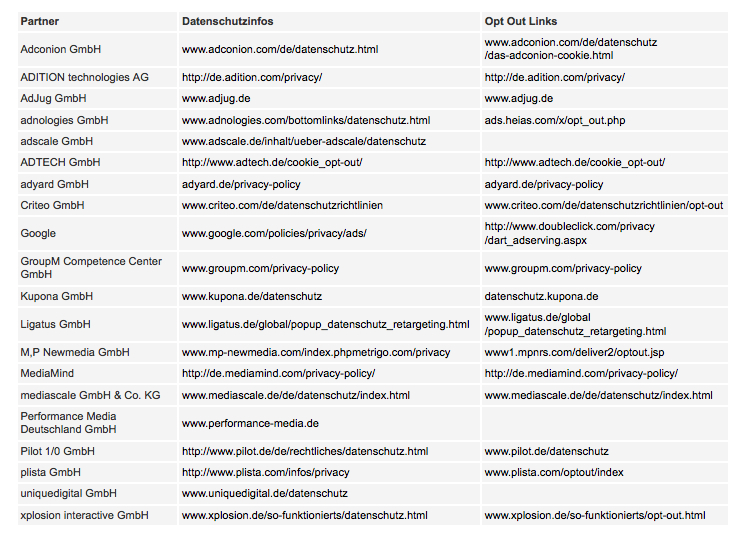
Now that it is obvious that Playboy.com has third party tracking cookies the question becomes – so what ? Does Playboy.com mention cookies in there Privacy Policy ? Yes they do. Do they mention third party cookies ? No, they do not. Here is their Privacy Policy http://www.playboy.com/privacy-policy. However, in all fairness, legally they do not have to. However, on Playboy’s German based site, Playboy.de, they are required by EU privacy laws to disclose such information. Here is the third party cookie information from Playboy.de ( http://www.playboy.de/ ) which can be found at the very bottom of the footer by clicking on this link Über unsere Werbung ;

Data collection of other service providers in usage-based online advertising

In order to optimize advertising to you based on your user interests, we have allowed these other companies to collect usage data. On the websites of these companies for more data protection information to the respective offer:

As you can see third party cookies and mainstream advertising are now very much part of the acceptable business model of porn in the United States. And while the European Union may have passed a new stringent privacy law we have yet to do so here. You as an American have much less privacy rights online then surfers in most of the other developed countries in the world.

So the next time you are surfing your favorite pornsite or tubesite you may just want to consider who’s watching you as you’re getting off to your favorite adult star. Big brother is watching and he likes porn. Make sure you read the Terms of Service and the Privacy Policy of the adult sites you visit and if that site has a European counterpart – read their Privacy Policy as well. It might surprise you to see who’s cookies are being inserted into your computer.

For more information on third party cookies you can visit http://www.allaboutcookies.org/privacy-concerns/

If you want to remove third party cookies from your computer and prevent them in the future you can visit http://www.allaboutcookies.org/manage-cookies/

Porn 101: Should I Trademark My Name ?

This is the second in a continuing series of articles about talent protecting their most important intellectual property, their stage name. In “Choosing Your Pornstar Name” ( https://adultbizlaw.com/?p=547 ) I discussed how to choose the best stage name possible. In this article I will discuss the importance of securing a trademark for a performer’s stage name.

There are three types of trademarks in the United States, common law trademark, a state trademark and a federally registered trademark. It is rather easy to get a common law trademark – it just requires the use of  that stage name in commerce – meaning once a performer opens a for-profit website with it and/or just starts using it as their stage name when they are booked into scenes and paid for those scenes. Commerce means the performer has to be using the name to make money. Unfortunately, a common law trademark is rather weak when it comes to protecting a “brand.” Common law trademarks are usually restricted to geographical locations and the industry the name is used in. For instance if you choose “Suzie Suckems” and use that name as your stage name you do have a common law trademark in “Susie Suckems.” Your common law trademark for your name will probably be restricted to the geographically area known as Los Angeles county (if you perform and live there). Also, you would probably only be able to enforce that common law trademark against another performer using the stage name “Susie Suckems” only in Los Angeles county and only as a stage name. Anywhere else the other “Susie Suckems” could use that name as a stage name and you would be unable to prevent her use of it. For instance, if the other “Susie Suckems” traveled to Florida to shoot she could certainly use it there.

A performer can also file for a state trademark, however I have never heard of anyone securing a state trademark. I do not believe that a state trademark provides any advantage over a federal trademark. I would never recommend that a performer-client register a state trademark before attempting to secure a federal trademark. Federally registered trademarks provide much more protection then a state trademark. Therefore, I always recommend that performers secure a federal trademark first. However if you would like to research California state trademarks you can find more information here -> http://www.sos.ca.gov/business/ts/

If you would like to research other state trademark laws you can go here -> http://www.uspto.gov/trademarks/process/State_Trademark_Links.jsp

If a performer does decide to trademark their stage name this is a relatively easy process for an experienced trademark attorney, though it does take a rather lengthy amount of time. Most performers think that once the trademark fees are paid and the paperwork is filed that is all that is necessary and they immediately have their trademark. That is not the case. It can take up to a year or longer to secure a trademark. It is a detailed process and often performer’s stage names are challenged or rejected depending on what the name is or how the trademark description is written. While it may seem easy, it can get complicated if the USPTO’s (United State Patent and Trademark Office) attorneys require additional information or issue office actions against the registration.

A performer can certainly file their own trademark. For more information on how to do so you can look here -> http://www.uspto.gov/trademarks/process/index.jsp

What many performers do not understand is that usually multiple trademarks need to be filed depending on what uses the performer wants to protect. For example, one trademark in Class 41 will not protect that stage name for the use on t-shirts. The manner in which a trademark operates to protect a brand is that a company or performer has to register that trademark for each use that want to protect it for. Quite simply, to protect their stage name on the Internet would be one registration. To protect that same stage name for a line of t-shirts that would be an additional filing. If the performer wanted to protect a wide range of uses many filings would be necessary. For example, the owner of the mark “Fifty Shades of Grey” has filed the following trademarks;

Word Mark FIFTY SHADES OF GREY
Goods and Services IC 003. US 001 004 006 050 051 052. G & S: Soaps; perfumery; essential oils; cosmetics; preparations for the hair, skin, body, face, hands and feet; depilatory preparations; exfoliating preparations; shaving preparations; waxing preparations for the removal of hairIC 004. US 001 006 015. G & S: Candles and wicks for lighting; scented candlesIC 006. US 002 012 013 014 023 025 050. G & S: Goods of common metal; handcuffs; shackles; karabiners; metal grids; metal chainsIC 009. US 021 023 026 036 038. G & S: Recording discs; compact discs; DVDs and other digital recording media; tapes; recording discs; sound recordings; video recordings; recorded films; electronic publications; sunglasses; mobile phones; mobile phone accessories; mobile phone applications and softwareIC 010. US 026 039 044. G & S: Sex aids including ropes; marital aids; benwa balls, being adult sexual aids; adult sexual stimulation aids; vibrators; condoms; massage apparatusIC 014. US 002 027 028 050. G & S: Jewellery; costume jewellery; clocks and watchesIC 016. US 002 005 022 023 029 037 038 050. G & S: Paper, cardboard and goods made from these materials; printed matter; photographs; stationery; calendars; postcards; greetings cards; books; magazinesIC 018. US 001 002 003 022 041. G & S: Leather and imitation leather and goods made from these materials; animal hides; trunks and travelling bags; handbags, rucksacks, purses, wallets, holdalls; umbrellas; whipsIC 020. US 002 013 022 025 032 050. G & S: Furniture; mirrors; picture frames; articles made of wood, cork, reed, cane, wicker, horn, bone, ivory, whalebone, shell, amber; mother-of-pearl, meerschaum or plastic; garden furniture; pillows and cushions; mugsIC 024. US 042 050. G & S: Textiles and textile goods; bed and table covers; rugs; duvets; covers for pillows, cushions or duvetsIC 025. US 022 039. G & S: Clothing; footwear; headgear; lingerie, men’s underwear, hosiery, bathing costumes; dressing gowns; nightwear; costumes for use in role-playIC 028. US 022 023 038 050. G & S: Games and playthings; soft toys; playing cards; boardgames; gymnastic and sporting articlesIC 033. US 047 049. G & S: Wines; spirits and liqueurs; alcopops; alcoholic cocktailsIC 034. US 002 008 009 017. G & S: Smokers’ articles; matches; lighters for smokersIC 041. US 100 101 107. G & S: Education services; entertainment services; party planning; arranging of parties; hosting social entertainment events; production of films; sporting and cultural activities; arranging of conferences, seminars and symposiumsIC 045. US 100 101. G & S: Marriage guidance counselling; personal relationship consulting


You can see that the owner of the mark wanted to protect their trademark for all possible uses, not just for a book or movie. More than $5,000.00 was paid just in registration fees for all of those uses in addition to the actual attorney’s fees paid for each filing. I often caution performers from trying to file too many registrations at once. It is often better to secure the main use first and then move towards additional uses as business opportunities allow. Otherwise it may be a rather expensive experiment to determine whether you can even secure the trademark for the first use.

For example, if your performer name is “Trixie Minaj” you may have difficulty in securing even the first trademark. Especially, if you have given interviews early in your career that you picked that name because people told you that you look like “Nicki Minaj.” The way the trademark process works is that once your trademark is filed it is reviewed within a couple of months by the staff attorneys at the USPTO. If all of the forms are properly filled out and the necessary samples of the use of the stage name are properly submitted your trademark will eventually be published for opposition. Which then means anyone can object to your trademark, if for some reason, your trademark is too close or infringes on their intellectually property. In this example, you can be assured that Nicki Minaj has attorneys that do nothing more than watch to see if anyone has tried to secure a trademark using her name. Once they do find it you can assume they will object to your trademark. If you have filed your trademark request in 10 different categories for 10 different uses you will probably lose all of those filing fees as well as the attorney’s fees paid on those trademarks. Thus, I always recommend that a performer try to get just one trademark first and then expand.

You might be asking why do I need a trademark anyway. In the realm of porn and pornstars the most common benefit of having a trademark is preventing others from securing domain names using a performer’s stage name. For example, if a you had a trademark on your stage name “Susie Suckems” you could force anyone using the name “Susie Suckems” in their website domain name to turn that domain over to you. If you had to purchase the domain name “www.SusieSuckemsXXX.com” because someone else was already using the domain name “www.SusieSuckems.com” for their website and they were posting photographs and videos of you on it you could then legally challenge their ownership of that domain name. Now if the other “Susie Suckems” was a country singer and her website had her music on it then you would probably not be successful since there would be no reason for a potential fan to confuse the country singer Susie Suckems and the pornstar Susie Suckems. The legal theory behind trademarks is to prevent potential fans/customers from confusing two marks in different industries. For example there are several companies legally using the trademark “Delta” in their names – Delta Airlines, Delta Faucets and Delta Dental. Obviously, the reason for this is that they all use the name Delta in different industries and there is little chance that people would think that Delta Airlines are now manufacturing faucets or filling cavities.

If there is a chance of consumer confusion between a performer and the person or company using their domain name there are two challenges that could be filed. The first is a UDRP action which is where a performer can file a request with the company that runs the assignment of domain names (ICANN) to have that domain name transferred back to that performer from the person that is using it without their permission. That person would have the opportunity to tell ICANN why they believe have rights to use the performer’s trademark in their domain name. If ICANN decides in the performer’s favor they have the power to simply seize the domain name and return it to that performer.

If the person or company is using a performer’s domain name for a membership website and is making money from off a performer’s trademark he/she can file a trademark infringement lawsuit against that person or company. A trademark lawsuit is much more expensive to defend for the person or company using the trademark. That alone may force them to turn over the trademark to the performer and if warranted, pay money as part of the settlement. Many infringers do not want the expense of litigation to try to keep a potentially domain name. However, be aware that with a UDRP action the performer only gets the domain name back. They do not get any monetary damages. Trademark lawsuits are complicated and can get rather expensive very quickly. I usually recommend that for domain name issues that most performers seek to have the domain name returned to them using the UDRP action option. It is much less expensive and much quicker.

Trademarks and protecting a performer’s stage name is vital to his/her long term success in the industry. It is what uniquely identifies a performer and is often “highjacked” by others looking to cash in on your success. It is strongly recommended that all performers seek out legal counsel and additional advice as to trademarks and their stage names. Failure to do so will ultimately cost that performer money and may result in others profiting where they shouldn’t. This discussion is much more complex that what I have touched upon in this article. A complete discussion of trademark law would require volumes.


Create a website or blog at WordPress.com

Up ↑