Has the US Senate Held FOSTA to Prevent a Pocket Veto ?

col2_senatefloorWe are now 13 days past the date of the passage of FOSTA, however, there is nothing that indicates FOSTA has become law. Usually, once passed by both the House and Senate, bills are presented to the President for signature unless there is some other work that needs to be finalized before sending it over.

According to Congress.gov, this bill has yet to even be presented to President Trump for his signature as of the time of this article (04/03/18 2:00 pm PDT)

https://www.congress.gov/bill/115th-congress/house-bill/1865

If you read my earlier article, I speculated that on March 29, 2018, that there could be a pocket veto of FOSTA if Trump did not sign it into law by midnight on March 31, 2018.

https://adultbizlaw.com/2018/03/29/will-trump-pocket-veto-fosta/

We are now 3 days past what should have been a deadline for a signature or veto. But yet there is nothing posted on the Congress.gov website indicating that the bill has been signed, vetoed or pocket vetoed. It just sits, unresolved. Since FOSTA passed on March 21, 2018, 24 other bills have been presented to the President and only 3 have yet to become law.

Could Congress have held presenting it to the President for fear of a pocket veto ? I do not know. President Trump, previous to FOSTA’s passage, indicated that he would sign it.

However, on Congress.gov, it fails to show that FOSTA has even been presented to the President for signature;

https://www.congress.gov/search?q={%22congress%22:%22115%22,%22source%22:%22legislation%22,%22bill-status%22:%22president%22}&pageSort=latestAction%3Adesc

So what is going on ? It is anyone’s guess at this point… so we wait.

Will Trump Pocket Veto FOSTA?

President-Trump-Official-PortraitBefore I begin, if you are reading this and do not know what FOSTA and/or SESTA are – I suggest that you read an earlier article I authored about it (link below). In short though, FOSTA is currently a bill that was passed by the House and Senate of the United States’ Congress that strips away any CDA section 230 protections from most websites and will allow law enforcement to prosecute anyone owns or operates websites that allow the advertisement of the services of an illegal prostitute or illegal escort. It will also allow for civil lawsuits against such websites as well.

https://adultbizlaw.com/2018/01/09/sex-workers-sesta-and-how-it-will-destroy-an-industry/

Currently, as of the time of the drafting of this article (March 29, 2018 at 3:30 PDT) President Trump as not signed FOSTA into law. Until he does, it remains a bill and not law yet. Eight days has passed since FOSTA was approved by the US Senate on March 21, 2018. Usually a President has 10 days in which to veto a bill before it automatically becomes law. In this case that 10th day would fall on Saturday. So Trump has until Saturday to veto the FOSTA or sign it. The question then becomes – what if he doesnt sign it or veto it ?

If Congress is not in session and a bill is allowed to expire without a President’s signature or expressed veto, it then becomes a “pocket veto.” FOSTA would not become a law and it would have to go through the entire process again of being reintroduced, voted on, passed and then once again presented to the President for signature or veto. Congress is currently not in session, since they are on break for the Passover and Easter holidays and will not return until April 9, 2018. So if Trump pocket vetoes FOSTA, there’s nothing the House or Senate could do immediately. However, there is an argument that they are only in a mid-session break and not out of session. There is some debate constitutionally what constitutes a break and being out of session.

If you would like some more information on vetoes and pocket vetoes, clink this link;

https://www.senate.gov/CRSpubs/090a8d2a-c3f8-4c8a-9e48-e47dc35a11d9.pdf

By the time you read this, Trump may have already signed it into law, but it is still possible that he will allow the bill to expire and use his ability to pocket veto it. If he doesn’t sign or veto it, there is an argument to make the FOSTA is not law.

Just something to consider…

Sharing Cam Tokens? That Could Make You a Prostitute, a John or even an Employer!

Arrested witchThis issue has recently come up during several conversations I have had with a few cam performers, both male and female. From these discussions, it appears that it is a rather common practice for two (or more) cam performers to get together to perform together on camera and then share the tips/tokens/revenue generated by that show.

While in theory this might sound like a great idea, however, it may not be. The “sharing” of revenue may actually be the payment of wages – which could make the performer paying the other performer an employer in that situation.

The definition of an employer from USLegal.com

An employer is a person or entity who hires another to performs service under an express or implied agreement and has control, or the right to control, over the manner and means of performing the services. An employer has the right to control an employee…

Other factors indicating an employee-employer relationship include payment of compensation on an hourly, salary, or commission basis, the employer’s maintainence of a place of business and supplying of tools and equipment, an indefinite time period for completion of services, and others.

Sharing tokens/tips/revenue from one performer’s account to another is actually a payment of commissions from one performer’s account to another performer’s account.

So in this instance, Performer 1 says to Performer 2, come to my apartment on Saturday at 8pm and we can do a camshow together and we will split the tokens we make. While that sounds reasonable, it in actually may create a legal relationship not intended.

Since Performer 1 is supplying the location, the camera and computer equipment to broadcast the show, has determined when the show (work) shall commence and end and how the work will be performed and will transfer tokens from his/her account to Performer 2, that begins to look like a traditional employer-employee relationship. Even though it is a commission based payment, it is still payment for services.

You may be asking, “so what?” Here is the larger issue with sharing tokens – as an employer – you have a legal responsibility to your employees – which varies state by state. In California, employers are required to have workers’ compensation insurance in case of an injury during employment. If Performer 2, completes the camshow and then falls and hits his/her head in the shower after the show, that very well could be a work related injury. Your homeowner’s or renter’s insurance may not cover such an accident. Which would then make Performer 1 liable for costly medical bills of Performer 2 while they seek treatment and recover from their injury.

Also, employers are usually responsible for paying employment taxes for their employees. Failure to do so can result in large tax bills for Performer 1 for penalties and interests for failing to pay such taxes. Tax liens can then be placed on someone’s assets for failure to pay such.

If you are Performer 1 and require Performer 2 to have an STD test in order to perform with you, then, as an employer, you may be required to pay for that pre-employment testing.

As an employer, you might also be required to use condoms or other barrier protection (dental dams) during the shoot to protect your employee(s) from contracting any STDs during the camshow. In California, failure to do so can result in very large fines by CalOSHA.

And finally, if you are located in any other state beside California or New Hampshire, the model release that you may be using for this shared camshow may not even be legal. Hardcore porn production (insertion/penetration of orifices) is only protected in those two states. In every other state, its illegal at worst and minimally protected at best.

However, no where is it allowed that the person paying for scene can also be the person engaging in the sex act during the scene – that is still considered prostitution. In this example, Performer 1, who is paying Performer 2 and performing in the scene would be guilty of the crime of solicitation of prostitution and Performer 2, who received the payment, would be guilty of the crime of prostitution – in every state.

Will you be arrested for doing a camshow with someone – probably not. However, the model release might not be valid. Contracts for illegal activities are not enforceable in court. Again you might be asking “so what?” The truth is that if Performer 2 gets a significant other 2 weeks after your camshow and they no longer want their images/video on your website, clipstore ect – they can demand that you take down the video and stop selling it. Without a valid, legal model release, you have no right to distribute the content.

Before you decide to “hire” other performers to perform, you really need to investigate the relationships created by such an arrangement and the payment of commissions.

Here are some other articles I have authored on related issues;

Work Comp: Performers – EEs vs. ICs

Who Should Pay for Performer Testing ?

The Problem with Producing Porn Outside California…

Win A Date With !! – Are You Running an Illegal Lottery ?

imageAre you a cam performer or pornstar that offers his/her fans a chance to “Win a Date With” with you contests ? Do you require that whomever enters the drawing actually buy something from you – a camshow, a DVD, a signed photo – anything of value? Well, if so, you are probably running an illegal lottery.
By requiring that a “purchase is necessary” you are asking someone to buy a ticket with a chance to win by being selected randomly. This is really no different that buying a $1 lottery ticket to be able to win $450 million dollars. Granted, while your date may not be worth $450 million dollars, it does have value. And since it does have value and a purchase is necessary – under most state laws – that is the definition of a lottery. Running an illegal lottery is a felony in most states and punishable by more than a year in state prison.

And if you are doing it via the Internet, on your website or social media accounts, then you might be running an illegal lottery in all 50 states since the offer is open to anyone in any of those states. Lotteries often restricted to citizens of certain states because of this reason.

What other laws might your “Win a Date With” contest be violating ? Obviously, depending on what happens on that date – prostitution. Selling a ticket for a chance to have sex with someone is still prostitution. Most prostitution statutes discuss the exchange of something of value of for sexual gratification. Even though it may be only $20 to buy your DVD, that is still value.

But what if you do not have sex with the contest winner – well that is still considered escorting without a permit/license which may still be a crime. In Los Angeles, there is a local municipal code that states;

LAMC 103.107(b) states “no person shall conduct, manage or carry on any escort bureau without a written permit from the Board. No permit under this section shall be issued to, or in the name of, any organization, group, corporation, partnership or any entity other than an individual person. The business may be advertised and carried on by the permittee under a fictitious name in the manner permitted by law if such fictitious name is first approved by the Board.”

a) Escort Defined. As used in this article, “Escort” means any person who, for a fee, commission, hire, reward or profit, accompanies other persons to or about social affairs, entertainments or places of amusement or consorts with others about any place of public resort or within any private quarters.

(b) Permit Required. No person shall be engaged as an Escort without a written permit from the Board. Such permit shall be issued to the address of the employer.

Even just being a paid companion requires a permit. Giving your time as a reward would also be considered escorting. What is the penalty in Los Angeles if you escort without a license? It is the same as though you were convicted of a prostitution charge. This is how LAPD gets most women caught in prostitution stings. Even if the alleged prostitute does not say she will have sex in exchange for money, merely showing up at a hotel room for a “date” is a violation of LAMC 103.107 and carries the same penalties as a prostitution conviction – up to a year in jail.

Los Angeles is not the only city with escorting laws either. Many cities have laws like the Los Angeles Municipal Code that makes escorting without a license a crime.

So what do you have to do to not run an illegal lottery or violate various prostitution/escorting laws ? There is no easy answer; since it depends where you will offer your drawing, what the prize will be, how will it be awarded, is there a cash value attached – there are many issues to consider.

This is something that I strongly recommend that you discuss with an attorney. You will need to have contest rules drafted. You will need to allow that people can enter without the need for a purchase. You may need to provide the gambling or lottery commission of certain states a copy of your rules and notice that you will be offering the lottery to citizens of their state.

What happens if you dont ? Well again, its more than likely a crime. You might ask yourself how would they ever find out? That could be as easy as phone call from a competitor or “hater” to a state’s lottery commission. Do not allow yourself to be vulnerable to prosecution.

Producers & Studios – Are You Giving Your Performers This Piece of Paper ?

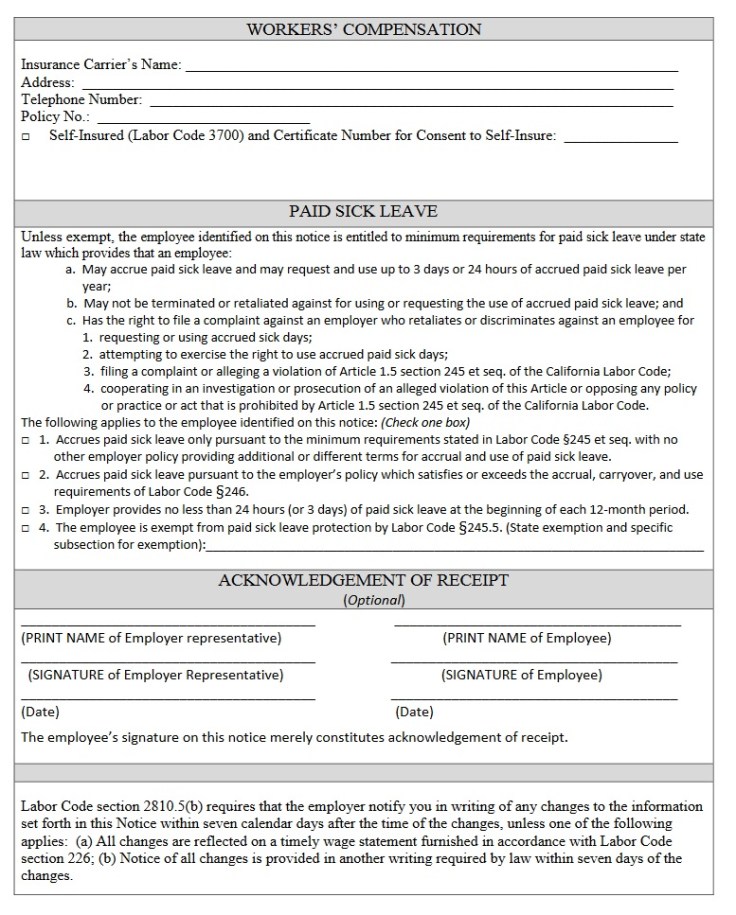
cropped-ablCalifornia has more employment laws than any other state. Trying to keep up to date is a daunting task for any employer – and yes, all studios and producers in California are employers. In 2011 the California Legislature passed the Wage Theft Prevention Act. This simple piece of legislation requires that all California employers provide a notice to all of their employees pointing out certain employment related information.

http://www.leginfo.ca.gov/pub/11-12/bill/asm/ab_0451-0500/ab_469_bill_20111009_chaptered.pdf

In an industry where it is sometimes difficult for a performer to know who they are actually working for, this notice is meant to clarify those issues as well as others. Employers are now required to use and provide this notice to all non-exempt employees when they are first hired. Meaning – this is another piece of paperwork, like a model release or 2257 document that must be filled out on set. The employer is also required to have the employee sign the document so that they can prove that the notice was actually received by the employee. Obviously, a copy must be provided to the performer.

So what happens if a studio or producer does not provide a copy of this notice to their performer-employees ? A civil penalty of one hundred dollars ($100) for each aggrieved employee per pay period for the initial violation and two hundred dollars ($200) for each aggrieved employee per pay period for each subsequent violation. Usually there is a 1 year statute of limitations for these types of claims.

If your studio produces 3 scenes per week with 2 performers per scene, each and every week, the potential penalty could be $31,200.00 (6 employees x 52 weeks x $100) for failure to provide the notice to your performer-employees. For a second violation those penalties would jump to $62,400.00. In addition to these fees, the studio/producer would also be responsible to pay attorneys fees.

Its important to note, the form requires a studio or producer to identify their workers’ compensation insurance company to the performer.

Here are some frequently asked questions…

http://www.dir.ca.gov/dlse/faqs-noticetoemployee.html

Here’s a link to download the form…

http://www.dir.ca.gov/dlse/LC_2810.5_Notice.pdf

Here is the form that the California Department of Industrial Relations has issued that should be used;

notice1

notice2

Sex Workers, SESTA and How it Will Destroy an Industry…

Check out all my signs!Over the past several months I have seen very little published or discussed about SESTA ( Stop Enabling Sex Traffickers Act) or the House counterpart legislation – FOSTA (Allow States and Victims to Fight Online Sex Trafficking Act). These are two pending Congressional bills that will dramatically alter not only the escort industry but also, quite possibly, the entire Internet.

The aim of each of these proposed bills is to fundamentally change the Communications Decency Act of 1934 and more specifically section 230 of that act. Currently, Section 230 generally immunizes Internet intermediaries from legal liability for hosting user-generated content. Many websites or services that we rely on host third-party content in some way—social media sites, photo and video-sharing apps, newspaper comment sections, and even community mailing lists.

Congress, both the Senate and House of Representatives, want to strip section 230 of those protections to make it easier to prosecute websites that advertise the services of escorts. Think of this as the “Backpage Bill.” However, instead of just prosecuting Backpage and its owners, now local and federal law enforcement will be able to prosecute any website that promotes escorting and/or prostitution.

Apparently, the government decided it is impossible to stop escorting and prostitution on a case by case basis, so the much easier alternative is to go after the websites that promote these services.

This has been a fight that has been going on for years. Here are some websites over the past 8 years that have been prosecuted or investigated for escort related activities or ads;

I might be missing a few but just from that list you can see the pattern that is emerging. They obviously believe that if escorts can’t advertise on the Internet – sexual services will just disappear.

However, law enforcement taking down a handful of escort website isn’t enough for US Senators or Congressman. They want to be able to tell Twitter, Facebook, and Instagram to block all prostitution related accounts, profiles and ads. Thus, the need to fundamentally change CDA Section 230 that provides them immunity from what is posted on their social media sites.

For awhile the large Internet companies were strenuously opposed to SESTA and FOSTA, however, they have recently been softening to the idea of legislation that will only target sex workers (or so they think).

Luckily, the Electronic Frontier Foundation is still vehemently opposed to both bills. They have built a website so anyone can send their objections to their Congressional representatives to stop SESTA and FOSTA.

If you are a sex worker (escort, porn performer, cam performer, dancer – ie., anyone that makes their income off of sex) or you love a sex worker or just support what they do I urge you to use EFF’s website and send a message to your Congressional representative and join in the fight to Stop SESTA and FOSTA !

https://stopsesta.org/

Got Posters ? No… You need labor law posters…

2018-FedPoster_CatIMGAlmost everyone that has worked a regular job at one point in their life have seen labor and employment law posters in their employer’s break or lunch room. Employers are required by law in all 50 states to post notices such as these.

Even though your company may be an adult content production studio, a cam studio or even a home based business, you are not exempt from posting these notices either at your office/studio or on set – which would be your workplace.

But you’re saying, I don’t have employees, I have independent contractors. The answer to that is – no, you don’t have independent contractors, you have employees. Almost no one is an independent contractor in California. Your attorney, your CPA, your licensed plumber or licensed house painter may be your independent contractor but few others are considered independent contractors in California.

In California employers are required to have notices posted about the following regulations and laws;

  • Paid Sick Leave
  • Discrimination Notice
  • Your Rights and Obligations as a Pregnant Employee
  • Family Care, Medical, and Pregnancy Disability Leave
  • Unemployment Insurance
  • CALOSHA – Health and Safety Protection
  • Access to Medical and Exposure Records
  • EDD Notice to Employees
  • Workers’ Compensation
  • Payday Notice
  • Time Off to Vote Notice
  • Emergency Phone Numbers
  • Whistleblower Protection Act
  • California No Smoking Poster
  • Transgender Rights in the Workplace
  • California Minimum Wage
  • Family and Medical Leave Act
  • Employee Polygraph Protection Act
  • Equal Employment Opportunity is the Law
  • Federal Minimum Wage
  • USERRA – Uniformed Services Employment and Reemployment Rights Act
  • OSHA – Job Safety & Health Protection
  • IRS Withholding Notice
  • Anti-Discrimination Notice
  • Payday Notice

And even certain cities and towns in California have their own posting requirements.

The adult industry has their own notice posting requirements. In Los Angeles County, because of Measure B, adult content production studios need to have a poster displayed in regards to the use of condoms by talent.

The good news is that you can buy all of the posters that are required (except the condom notice poster) without the need to contact an employment or labor law attorney. Failure to post these notices can result in fines from various governmental agencies, local, state and federal as well as a diminished ability to defend against certain labor or employment lawsuits.

You can find posters for all 50 states and various cities here;

https://www.laborlawcenter.com/


Are All Photographers, Videographers, Shooters & Directors Employees ?

cropped-ablOne of the most used agreements in California for adult content production is the standard “Work for Hire Agreement.” It is basically an agreement that assigns the copyright of the photographs, videos or clips captured during a scene to the company or studio that has paid to produce the content.

Note: If you are not having your photographers, videographers, shooter and/or directors sign a work for hire agreement for each and every photograph and video, then you probably don’t own your content. And you might want to check with your attorney about this or hire one to review your situation before its too late. This situation is more common that people believe.

Under U.S. Copyright law, the person who captures the content is the actual copyright owner, not the person who pays for the content. In more legal terms;

A copyright is a legal device that gives the creator of a literary, artistic, musical, or other creative work the sole right to publish and sell that work. Copyright owners have the right to control the reproduction of their work, including the right to receive payment for that reproduction. An author may grant (assign) or sell those rights to others, including publishers or recording companies.

Notice the word “creator” that I placed in bold and italicized ? The creator is the person who captures and fixes the images onto a photograph or video recording, not the person who paid the performers to perform. In order for companies or studios to gain those copyrights from the creators so that they can distribute the content – a work for hire agreement is used. Once the creator has a signed work for hire, the studio can sell the content or post the photographs, videos or clips to whatever website they want or distribute them via DVD, broadcast or cable. Without a signed work for hire, then the studio or company only has a oral license (agreement) to use the content which can be revoked at any time by the creator, in writing, even after the content has been sold and distributed. This would create a nightmare of epic proportions though.

A work for hire agreement is one way for the studio to own the copyright to the content. The other way is to make your photographer, videographer and/or director an actual employee of the studio. Then everything that they do is owned by the studio under the legal theory of master-servant. Generally, if someone is your employee then you own all of their inventions and creations, including copyrights. However, in order to call them an employee, they must be on payroll AND you must pay employment taxes on that person’s earnings. You cannot just pay them a flat day rate.

Most studios and companies do not pay payroll taxes on their creators. Most get the creators to sign a work for hire. And there is the problem that few in California now know about.

In 2012, the California Legislature passed Labor Code section 3351.5(c) which states;

3351.5. Employee includes:

(a) Any person whose employment training is arranged by the State Department of Rehabilitation with any employer. Such person shall be deemed an employee of such employer for workers compensation purposes; provided that, the department shall bear the full amount of any additional workers compensation insurance premium expense incurred by the employer due to the provisions of this section.

(b) Any person defined in subdivision (d) of Section 3351 who performs domestic service comprising in-home supportive services under Article 7 (commencing with Section 12300), Chapter 3, Part 3, Division 9 of the Welfare and Institutions Code. For purposes of Section 3352, such person shall be deemed an employee of the recipient of such services for workers compensation purposes if the state or county makes or provides for direct payment to such person or to the recipient of in-home supportive services for the purchase of services, subject to the provisions of Section 12302.2 of the Welfare and Institutions Code.

(c) Any person while engaged by contract for the creation of a specially ordered or commissioned work of authorship in which the parties expressly agree in a written instrument signed by them that the work shall be considered a work made for hire, as defined in Section 101 of Title 17 of the United States Code, and the ordering or commissioning party obtains ownership of all the rights comprised in the copyright in the work.

Which means that in California, if you have a creator sign a work for hire agreement, they are now legally and automatically classified as employees for unemployment benefits and workers’ compensation benefits. It doesn’t matter what the studio or even the creator want to classify themselves as. This law overrides any private agreement.

If those creators want to file for unemployment benefits, under California Labor Code section 3351.5(c) – they can. If they are injured on set and file for workers’ compensation benefits, the studios and companies can no longer claim they were independent contractors and not entitled to benefits.

Many adult producers, large and small, ignore issues surrounding employment law and how those laws interact and can change their understanding of intellectual property law. It is vital to understand the specific employment laws of your jurisdiction if you happen to produce outside of California. Other states may have adopted a similar approach to copyright and employment law.

You should also talk to your Certified Public Accountant about this issue since employment and payroll taxes are involved. Failure to pay payroll taxes can result in fines, penalties and in extreme cases – imprisonment.

PornLaw on Bryan Callen’s Podcast

hangover

You might be asking so what ? And you might be saying who the hell is Bryan Callen ? Well you might not know him by name but I guarantee that you know his face. Bryan Callen is an extremely funny guy and he is my favorite actor from The Hangover I and II. You might remember him as the wedding chapel owner, Eddie, and Samir the strip club owner in Hangover II. And more importantly, he and I are fellow alumni from the American University in Washington D.C.

So when I got the call to meet him at his home to do his podcast “The Bryan Callen Show” I jumped at the chance to sit down and talk with him about the industry, being a porn lawyer, some of my clients and being married to Vanessa Blue. I obviously wont give away the show but I will link to it once it goes up so you can listen for yourself !

Click here if you want to listen to my interview with Bryan —

http://mixedmentalarts.libsyn.com/website/ep11-michael-fattorosi

And I also have to thank him for the very generous gift he bestowed on me after we were done with taping the podcast. When I told him I had a blog in which I also reviewed different brands of scotch he gave me a bottle of 18 year old Glenmorangie. That my friends is a very expensive bottle of scotch.

Can You Get Sued for Pretending to Be Your Favorite Superhero or Villian during a CamShow ? Probably so…

cropped-ablMany performers (and cam studios and camsites) do not understand that famous and popular characters from movies and comic books are copyrighted and are protected as the intellectual property of the company or person who created them.

This issue is, for the most part, ignored by performers and even producers. You couldn’t create a Darth Vader doll and sell it on your website. Most realize that would be a violation of Disney’s rights to merchandise their characters and their “Star Wars” movies. Why then is pretending to be Darth Vader (or any other character) not seen to be the same violation of intellectual property rights ?

For Disney, it is the same. And they have filed a lawsuit against a company in New York that rents out characters such as Darth Vader, Luke Skywalker, Iron Man and Elsa from Frozen. Disney claims that the company, Characters for Hire, LLC, has been infringing on their copyrights and trademarks in their various characters.

From The Hollywood Reporter – https://www.hollywoodreporter.com/thr-esq/disney-fights-unlicensed-star-wars-frozen-characters-at-childrens-birthday-parties-1049247

“Disney alleges that Sarelli has a “knock-off business … built upon the infringement of Plaintiffs’ highly valuable intellectual property rights,” including the fictional characters Darth Vader, Iron Man and Elsa and Anna from Frozen. Disney is upset how this company “provides unlicensed and poor quality appearances and performances” by actors dressed as “iconic characters for themed events, such as children’s parties.”

The lawsuit claims that the costumed actors appearing at these events and the advertising associated with this enterprise represent a violation of both its copyrights and trademark rights.”

The same can be claimed as to anyone using a character during a camshow that is being broadcast over a camsite. It is no different than if the performer was playing a song during the camshow that was not owned by the performer. That would be an infringement on the intellectual property of the writer of the song, the performers singing/playing the song as well as the record company that owns the broadcast rights.

Appearing as your favorite superhero or villian could be considered a parody though. However, that is factual analysis and must be closely examined – after you, the studio or the camsite has been sued, for a court to determine whether the limited fair use defense would apply. There is also the issue that using the trademarked character in a pornographic performance would be considered dilution of their trademark as well as  tarnishing the their trademark. A trademark is tarnished when an infringing mark portrays the infringed mark in a negative light- usually in the context of sex, drugs, crime, etc.

The moral to the story – invent your own characters (and copyright/trademark them) instead of using your favorite superhero or villian in your camshows and clips.


Create a website or blog at WordPress.com

Up ↑