So You Broke Up with Your Scene Partner – Now What ? Who owns your content ?

cropped-ablOne of the most common issues that I have been asked about by performers is – who owns the content when a relationship ends. Many performers/producers use their significant others in scenes as a way to minimize costs. That can be a smart approach, IF, it is done correctly. Most of the time it isn’t though.

Industry people tend to believe that the person that pays for the content and the associated costs (hotel room, testing, equipment ect) owns the content. This is false. Some believe that since they own the camera that was used to film the content – they would then own the content, again this is false.

It is the person that actually holds the camera and captures the scene that owns the copyright to the content. If that is not you, then you merely have oral license to use the content until, your ex-significant other, the actual copyright holder, sends you notice to cease and desist your use of the content, usually after your relationship ends. Oral copyright licenses can easily be terminated in writing. It is also quite possible that whomever edits your content also will hold an ownership/copyright interest in your content. Since it is their work and vision that creates the final product.

Depending on the number of scenes at issue, this can wipe out your entire website or clips’ store and drastically affect your revenue until you can replace the content. And if you decide that you are going to dispute your ex-significant other’s claim to the content, be prepared to spend thousands in attorney fees. This can be a very complicated issue to figure out – after the scenes have been shot and edited. Sometimes those fees are more than what the content is actually worth or could be replaced for.

None-the-less, it is vital that you own or at least share in the rights to the content. In order to do so you will need signed “Work for Hire” releases assigning the copyrights in the content to you from your photographer, videographer and editor. If you do not have these documents for every single scene, you need to immediately re-evaluate your content ownership rights. Without “Work for Hire” agreements on each and every scene, you do not own your content.

This will be one of the topics I will cover during my upcoming seminar at AVN/AEE 2018 in January in Las Vegas. If you are unsure of your content ownership rights, I suggest that you sign up and attend my seminar.

https://adultbizlaw.com/2018/01/02/free-performer-seminar-avn-aee/

For more information on copyright and who owns your content please see;

https://adultbizlaw.com/2012/07/30/who-owns-your-content/

The EU’s General Data Protection Regulation (GDPR) and How it Affects You

ablThe General Data Protection Regulation (GDPR) is the biggest overhaul of EU data protection law in more than 20 years. It replaces the current EU Data Protection Directive and aims to create unified data protection legislation covering all individuals in the European Union. It will take effect on May 25, 2018.
GDPR is designed to increase the protection of personal data for all EU residents regardless of where it is collected or stored. The extraterritorial nature of the regulation will be felt globally, because all companies that capture data of EU residents will be required to comply with the legislation. Do you have customers in the European Union ? Then you will have to comply with the GDPR.

The application of this law to your business will be determined by what, if any, personal information you collect from your members/surfers.

“Personal data” is defined in the GDPR as any information relating to an person who can be identified, directly or indirectly, in particular by reference to an identifier such as a name, an identification number, location data, online identifier or to one or more factors specific to the physical, physiological, genetic, mental, economic, cultural or social identity of that person.

So in many cases online identifiers including IP address, cookies and so forth will now be regarded as personal data if they can be (or are capable of being) without undue effort linked back to the data subject.

Does your site request information of your members and or surfers that can be classified as personal ?

If you are concerned that your billing company or processor requests this information – be aware they will have to comply with the GDPR. If you do not request information from your surfers or members then you probably do not need to concern yourself with compliance. However, even if you collect email address through an online form, that may be considered personal data. A person’s online identity can also be considered personal data. For example, I am known as “pornlaw” on many social media accounts. It would not be difficult to identify me solely from that name so therefore, that would be considered personal data under the GDPR. What exactly is personal data is a complex question with no real answers at this point.

However, here is more information on personal data or identifiers —

https://www.i-scoop.eu/gdpr/gdpr-personal-data-identifiers-pseudonymous-information/

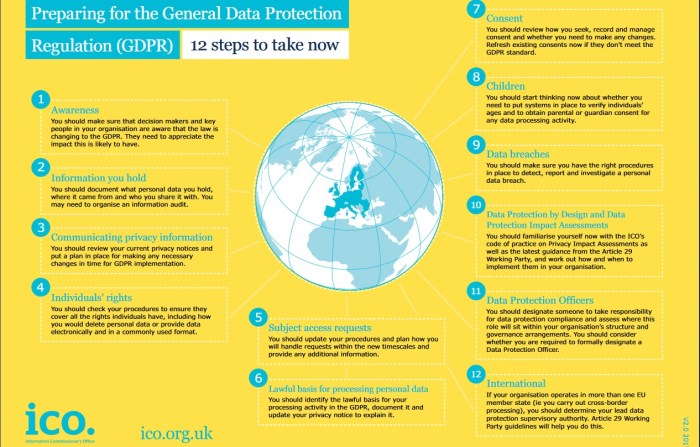
So now that you have decided that you do indeed collect personal data from your surfers/members – how do you come into compliance by May 25, 2018. Take a look at this infograph from the Information Commissioners Office in the UK;

gdpr

You can download a full copy of their “Preparing for the General Data Protection Regulation (GDPR): 12 steps to take now” here…

https://ico.org.uk/media/1624219/preparing-for-the-gdpr-12-steps.pdf

This is an excellent straight forward, albeit lengthy (11 pages), explanation of how to be compliant with the GDPR.

Are you confused ? A lot of people are. But are you ready to be compliant by May 25, 2018?

Free Performer Seminar @ AVN/AEE

ablI am considering offering a free legal seminar for performers during AVN/AEE in January in Vegas – if there’s any interest. I do know its a busy show for performers though. Whether you are a cam performer, porn performer, fetish performer, or even a small independent producer – all are welcome. I want to tailor the seminar to what you want to know. An hour is not much time but the I am often asked the same questions by performers. And there are some issues performers are not even aware of – until it is too late.

Some of the topics I am most asked about are;

  • Model Release Agreements – Don’t give away too much!
  • Camsite & Cam Studio Contracts – Can they stop me from working ?
  • Shooting Fetish Content – What’s Legal and What’s Not!
  • Content Trades – You’re Probably Using the Wrong Agreement!
  • 18 USC 2257 – Do I need to use my real address ?
  • Shooting with Your Significant Other – What happens if we break-up ?
  • Work for Hire Agreements – Do you even own your content ?

There are so many issues that you have to be aware of as a performer/producer. This is just the basics. It can be overwhelming whether you are brand new to the industry or are a veteran. Anyone that attends will also receive a packet of my content production documents. (Model Release, Content Trade Release, Work for Hire Agreement, Independent Contractor Agreement, Location Release and 2257 Document) Usually I sell these for $100 but I will make them available for free – digitally for anyone who attends.

If you are interested in attending please use my Contact Us form and send me your email address so I can add you to the list. If there is enough interest I will find a location and send you the information as to the date/place/time of the seminar. Please feel free to suggest a topic that you may want to have me discuss.

If you can only attend online – please let me know as well. If there is enough interest for streaming the seminar live or recording it – I will try to set that up as well.

I hope to see you in Las Vegas !

https://adultbizlaw.com/contact/

UK’s Age Verification Law – What You Need to Know as a US Company, Producer or Performer

ablSome of you may be aware and some may not – but in April 2018 an age verification requirement will go into effect in the United Kingdom. As part of the Digital Economy Act all adult websites will need to comply with insuring that their visitors and customers are 18 years of age or older. Yes, even visitors to your website will need to be verified before being able to enter.

And this is not the simple “Enter Here if You Are 18” that many sites now use in the US. This will require websites to actually check the ages of the surfers. No more free porn to minors in the UK!

Under the yet-to-be-implemented measures, free and fee-based porn operators—many of which are based outside of the UK —will be required to insert age checkers on their sites in the UK, forcing users to dish up their credit card details to prove that they are 18 or over before being granted access to their content.

Companies that do not implement these methods by April 2018 could face repercussions, like being blocked by internet service providers, paying a fine, or being denied access to payment websites like PayPal.

Under the new law, online porn sites are threatened with a fine of £250,000 ($335,000 US) or 5 percent of their annual profits if they are caught failing to verify the age of any of their users.

The British Board of Film Classification will be responsible for implementing the new policy.

What does this mean for you ? If you do business in the United Kingdom – meaning – is your website accessible by anyone in the United Kingdom (England, Scotland, Wales and Northern Ireland) then you will need to comply with the law. You can also obviously block any IP addresses coming from one of these countries if you decide that you do not want to comply but then you lose out on all of your UK members and potential sales.

For more information –

http://www.wired.co.uk/article/porn-block-ban-in-the-uk-age-verifcation-law

https://news.sky.com/story/government-proposes-bbfc-as-new-age-checking-pornography-watchdog-11170517

https://www.theguardian.com/technology/2017/jul/17/age-checks-introduced-porn-websites-uk-credit-card-details


Is Your Adult Web Site Accessible to the Disabled ?

ablYes, you read that correctly – your adult website has to be ADA compliant. You may be asking what does ADA compliance have to do with websites. However, just like restrooms, parking places and two story buildings with stairs – your website will have to offer the means so that people with disabilities may access and enjoy your products.

What does this mean exactly ? Here is a list of suggestions from the Department of Health and Human Services on how your website may be compliant;

  • Every image, video file, audio file, plug-in, etc. has an alt tag
  • Complex graphics are accompanied by detailed text descriptions
  • The alt descriptions describe the purpose of the objects
  • If an image is also used as a link, make sure the alt tag describes the graphic and the link destination
  • Decorative graphics with no other function have empty alt descriptions (alt= “”)
  • Add captions to videos
  • Add audio descriptions
  • Create text transcript
  • Create a link to the video rather than embedding it into web pages
  • Add a link to the media player download
  • Add an additional link to the text transcript
  • The page should provide alternative links to the Image Map
  • The <area> tags must contain an alt attribute
  • Data tables have the column and row headers appropriately identified (using the <th> tag)
  • Tables used strictly for layout purposes do NOT have header rows or columns
  • Table cells are associated with the appropriate headers (e.g. with the id, headers, scope and/or axis HTML attributes)
  • Make sure the page does not contain repeatedly flashing images
  • Check to make sure the page does not contain a strobe effect
  • A link is provided to a disability-accessible page where the plug-in can be downloaded
  • All Java applets, scripts and plug-ins (including Acrobat PDF files and PowerPoint files, etc.) and the content within them are accessible to assistive technologies, or else an alternative means of accessing equivalent content is provided
  • When form controls are text input fields use the LABEL element
  • When text is not available use the title attribute
  • Include any special instructions within field labels
  • Make sure that form fields are in a logical tab order
  • Include a ‘Skip Navigation’ button to help those using text readers

The question then becomes – what if your website is not ADA compliant ? In 2015 and 2016, numerous plaintiff law firms sent letters to scores of companies, universities and other entities on behalf of disabled individuals throughout the United States who use the Internet to facilitate their access to goods and services. The letters typically identify certain alleged ADA violations based upon “access barriers” on the recipients’ websites. The letters further claim that unless the recipient company modifies its website to meet the standards in the World Wide Web Consortium’s (W3C) Web Content Accessibility Guidelines (WCAG 2.0 AA), the company will continue to violate Title III. The WCAG 2.0 AA Guidelines have been endorsed by the DOJ.

In other words, you can be sued for not having an ADA compliant website no different that a restaurant can be sued for not having disabled accessible restrooms.

What should you do ? Start talking to your web-designer(s) about how to make your site compliant at some point in the near future. Otherwise, you will be risking litigation. More than 240 businesses across the country have been sued in federal court over website accessibility since the beginning of 2015. Adult websites will be low hanging fruit for many ADA litigation savvy attorneys and firms.

For more information — http://beta.latimes.com/opinion/op-ed/la-oe-pulliam-ada-websites-20170611-story.html

New Law in Japan: Performers Can Block the Sale of their Scenes after 5 years

ablIt appears that the Japanese adult industry cares for their performers to a much greater degree than the US industry. This seems to be a decision that will allow performers to “move on” from their adult careers without some of the stigma of being on video forever.

In this US this would require that all model releases be completely re-written so that the rights would terminate after 5 years. Now, when a performer signs a release – it is in perpetuity – meaning you have released your rights forever.

Click for more information —  https://japantoday.com/category/entertainment/new-rules-allow-japanese-adult-film-actresses-to-stop-sale-of-their-videos-after-five-years

Japan’s Adult Video Human Rights Organization (the successor to the Intellectual Property Promotion Association’s Adult Video Industry Reform and Promotion Advisory Committee) will be asking production and distribution companies to comply with a new guideline allowing actresses to halt the sale of adult videos they have appeared in. Actresses can exercise this option once the film has been commercially available for five years, or five years and six months after the film was recorded. Additionally, companies will also be restricted from using any of the footage in other products, such as pornography omnibus releases should an actress ask for a halt in sales.

“There is a risk that other people will find out about you appearing in an adult video, and there is also a risk of sexually transmitted infection.” Advocates of the new rules assert that many women enter into contracts to appear in adult videos without fully comprehending what the work entails, and so only after the actress receives a through explanation and signs separate forms of understanding and intent will production companies be allowed to enter into a contract with her to film pornographic content.

Why You Should Never Film Porn in Public

091817-news-couple-arrested-public-pornYou will go to jail. And you may end up on a sex offender registry. It’s really that simple and I am surprised I have to write a blog post about this though. However, I see many of the smaller producers and solo-performers/producers that post clip previews or live cam shows that clearly show that they filmed something in public. Whether it’s in a library, behind a desolate warehouse, a park or even outside your house in the pool, sex and/or nudity in public is a sure-fire way to garner someone’s attention which usually leads to the local police being called. Not to mention that your video, in itself, is evidence of the crime and can be used as evidence against you in a criminal prosecution.

Here are just a few of the cases that had made the news in the past couple of years;

https://www.bet.com/news/national/2017/09/18/couple-records-public-sex-and-uploads-to-pornhub.html

https://www.theglobeandmail.com/news/national/windsor-woman-21-arrested-in-library-sex-show-case/article23333730/

http://6abc.com/news/ex-oregon-state-student-charged-with-indecency-after-filming-solo-sex-act-in-library/497640/

Perhaps you may get lucky like an Australian couple who filmed themselves having sex at a train station – but that was only because the video was not discovered until the statute of limitations had expired and they could not be officially charged.

https://nypost.com/2017/01/19/couple-wont-be-charged-for-public-porn-shoot/

Many of you may be saying “so what – it’s a first offense, I won’t go to jail for that!”

You may or may not go to jail. For a first offense, you may receive a lenient plea deal from a District Attorney. He or she may say “just plead guilty and you won’t have to go to jail.” However, because of your guilty plea what is possible is that you may have to register as a sex offender. In 13 states merely urinating in public can get you placed on the sex offender registry.

Any type of public nudity is considered lewd behavior. California law under Penal Code Section 647(a) punishes any person who “solicits anyone to engage in or who engages in lewd or dissolute conduct in any public place or in any place open to the public or exposed to public view.” Further, California Penal Code Section 314 prohibits the sex crime of “indecent exposure” . . . which means willfully exposing your genitals to someone else, motivated by a desire to sexually gratify yourself or offend the other person. A California Penal Code Section 314 conviction subjects you to a minimum ten (10) year duty to register as a Tier one California sex offender. California Senate Bill 384 recently created a three-tier sex registration system that reduced the registration requirement for indecent exposure to ten (10) years. It used to be for life.

The criminal penalties in other states is not that much different than the example above from California. And in some, it is much worse.

Before you go off and start filming yourself camming topless from your car, flashing in a library, getting oral sex next to a dumpster behind a Walmart or masturbating in a restaurant, think twice – that $9.99 clip might end up costing you a lot more in legal fees.

DMCA Agent Designations Due by Dec 31st !

If you had an DMCA agent designated with the US Copyright Office you must renew your agent designation with the US Copyright Office by December 31st using their new online database registration system. If you do not, your agent designation will no longer be valid and you will lose any protection provided by the Digital Millennium Copyright Act (“DMCA”).

If you have a website and do not have a DMCA policy and a DMCA agent registered with the US Copyright Office, you need to. If you have a website that allows for anyone to post anything – videos, comments, photos – user generated content (UGC) – this is a must do.

Why do you need a DMCA policy and registered agent ? That will protect you in case of a claim of copyright infringement under the Safe Harbor provisions of the DMCA. See the link for an explanation from the Digital Media Law Project;

http://www.dmlp.org/legal-guide/protect … er-content

You dont need a lawyer to register an agent, but if you have one you might want to talk to him/her about making sure your agent designation is timely renewed.

Here’s is the letter from the US Copyright Office that you should have received if you had an agent registered under the old manual system.

U.S. Copyright Office Official Notice: Re-Register DMCA Agent in New Electronic System

Dear Designated Agent:
Under the Digital Millennium Copyright Act (“DMCA”) service providers can obtain safe harbor from copyright infringement liability by, among other things, designating an agent to receive notifications of claimed copyright infringement.
You are receiving this email because you are listed as the designated agent for an online service provider in the U.S. Copyright Office’s old, paper-based designation system. In December 2016, the Office introduced an online registration system. As part of the transition to the new system, the Office is requiring that any service provider that designated an agent with the Office in the old paper system must submit a new designation electronically using the online registration system by December 31, 2017 if it wishes to maintain an active designation with the Office. Registration in the new system only costs $6 and only takes a few minutes.
For more information about the new system, please visit https://www.copyright.gov/dmca-directory/. From this page you can access the new system to complete the registration process, review answers to frequently asked questions, and watch video tutorials showing how to use the new system.
Please note that any designation made in the old paper-based registration system will only continue to be valid until December 31, 2017, after which it will expire.
If you have already registered in the new electronic system, you can ignore this message.
Please do not reply to this message as it is being sent from an unattended mailbox. If you have any questions, or you do not wish to receive these reminders, please contact the Copyright Office at copyosp@loc.gov or (202) 707-1759.
Sincerely,
U.S. Copyright Office
www.copyright.gov

Cam Performers: Protecting Your Content

With the rise of camsites, there has been an explosion of the number of models whom only perform on camera from the privacy of their homes and bedrooms. Many are brand new to the adult industry and fail to realize there are certain issues that most mainstream producers have become, unfortunately, accustomed to; piracy.

I am often asked by new cam performers what can be done to protect their content and live shows from being pirated and then uploaded to various pirate sites and tubes. Often, not only does this lead to a decline in revenue for the performer, but also to a lack of privacy. Models on camsites can and do often block certain geographic regions so as not to be discovered for their performances. The pirating of their shows and content completely places them into a position of vulnerability.

But just like any other producer, a cam performer must understand the need to protect their content, possibly, even more so. The first mode of defense is to register their content with the US Copyright Office ( US Copyright Office ). Through the registration process, they can then be assured that their content is protected with the same force and effect as any mainstream movie. However, for the content owner to be assured of the possibility of being award statutory damages and attorney’s fees for any infringement, that registration must occur within the first 90 days of the date of public broadcast of the show or content. Failure to register within that time frames means that the content producer / model will need to prove actual damages and will not need be able to recover attorney’s fees. Proving actual damages in trial is almost impossible and would require that an expert witness in copyright damages be retained to testify – usually at a cost of $10,000 to $15,000. The expert fees alone usually are more than the potential damages to the model. Basically, without registering your content, you have no copyright infringement lawsuit.

However, even more important that using copyright law to protect your work, I suggest using trademark law. The Lanham Act is far more stringent on repeat pirates than copyright law. Every cam performer should trademark their stage name as well as the watermark that they use on their content. If some pirate removes your watermark from your video when they upload it that is called reverse palming off;

reverse palming off:

the wrongful misappropriation of another’s goods or services by removing the correct name or trademark and selling or offering the goods under a different name

This is no different that if someone removed the Nike “Swoosh” from the side of their sneakers, placed their own name on them and tried to sell them as “Bob’s Greatest Sneakers.” Bob didn’t make those sneakers so he is trying to pass off Nike’s goods as his own.

This is what usually occurs in the pirating of video content. Most pirates do not realize that removing a trademarked watermark is actual trademark infringement and a violation of the Lanham Act. The other benefit of using trademark law to protect your content is that unlike copyright law, there is no safe harbor for the pirates. Once a tubesite, credit card processor and/or webhost is placed on notice of the trademark infringement through a cease and desist letter, they must act to remove the infringing content. Failure to act means that an innocent trademark infringement claim can quickly become a willful infringement trademark claim.

For more information on trademarks you can read other articles I have written;

Piracy and Trademark Law: A Way Stop to Content Theft

Porn 101: Should I Trademark My Name ?

Create a website or blog at WordPress.com

Up ↑